Do Different Projector Screens Really Make A Difference
Yes, different projector screens make a big difference in picture quality, brightness, and color accuracy. The right screen material, size, and type can transform your home theater or outdoor movie setup. Choosing wisely means sharper images, better contrast, and a much more enjoyable viewing experience every time you watch.
You might think all projector screens are basically the same. They’re just big pieces of white fabric, right? Wrong. The truth is that different projector screens make a real difference in how your movies, games, and presentations look. Whether you are setting up a home theater or throwing an outdoor movie night, the screen you choose can make or break the experience.
The material, texture, size, and even the color of your screen all play a role in how sharp, bright, and colorful your projected image appears. A cheap or wrong screen can turn a stunning 4K projector into a blurry mess. On the other hand, the right screen can make even a budget projector look incredible. Let us dive into why this matters so much.
Key Takeaways
- Screen material matters: Matte white, gray, and high-gain screens each produce very different results.
- Size and aspect ratio affect immersion: A properly sized screen makes content look cinematic and professional.
- Portable and DIY screens work great: You don’t need an expensive fixed screen to get excellent picture quality.
- Ambient light changes everything: The right screen type can handle room lighting better than others.
- Budget options deliver quality: Affordable screens can rival premium options when matched to your setup.
- Your projector type should guide your choice: Matching the screen to your projector ensures the best possible output.
📑 Table of Contents
- Why Your Projector Screen Choice Matters
- Types of Projector Screens and How They Differ
- Screen Size and Aspect Ratio: Does It Matter?
- Portable vs. Fixed Screens: Which Is Better?
- DIY Projector Screen Options
- How Ambient Light Changes Everything
- Matching Your Screen to Your Projector Type
- Expert Insights: What Professionals Look For
- Common Mistakes People Make When Choosing a Screen
- Final Thoughts
Why Your Projector Screen Choice Matters
Think of your projector and screen as a team. Your projector creates the image, but the screen displays it. If one part of the team underperforms, the whole experience suffers. Many people spend thousands on a projector but then hang a plain white bedsheet on the wall. That is like buying a fancy sports car and putting flat tires on it.
The screen affects several key things. First, it controls image sharpness. A smooth, uniform surface keeps the picture crisp. Second, it manages brightness and contrast. Some screens bounce more light back to your eyes, while others absorb it. Third, the screen handles color accuracy. Different materials show colors differently, which changes the mood and realism of what you are watching.
Another big factor is ambient light. If your room has windows or lamps, the wrong screen will wash out your picture. The right screen fights back against light and keeps your image looking deep and rich. This is why understanding your options before buying is so important.
How Screen Material Affects Image Quality
The material of your screen is the single biggest factor in image quality. Think of it like paper for a printer. The same printer can produce very different results on regular paper versus glossy photo paper. Projector screens work the same way. The material determines how light bounces off the surface and reaches your eyes.
Most projector screens fall into three main categories. Matte white screens are the most common and versatile. They work well in dark rooms and provide natural color reproduction. Gray screens help boost contrast, especially in rooms with some light. High-gain screens focus light back toward the viewer, making the image brighter but narrowing the viewing angle.
Each material has a specific “gain” rating. This number tells you how efficiently the screen reflects light compared to a standard white surface. A gain of 1.0 is neutral. Anything above 1.0 amplifies brightness. Anything below 1.0 dims the image but can improve contrast. Understanding gain helps you pick the right screen for your room setup.
Types of Projector Screens and How They Differ
Not all screens are created equal. Different projector screens serve different purposes and environments. Let us break down the most popular types so you can find the one that fits your needs.
Matte White Screens
Matte white screens are the go-to choice for most people. They offer a neutral, natural look that works with almost any projector. These screens spread light evenly across the surface, which means everyone in the room sees a consistent image. They are perfect for dedicated home theaters where you can control the lighting.
The main downside is that matte white screens do not handle ambient light well. If you have a bright room with windows, the image will look washed out. That is where other screen types come in handy.
Gray Screens
Gray screens are designed for rooms that get some ambient light. The dark gray surface absorbs more light from the environment, which keeps your projected image looking deep and contrasty. Colors often appear richer on a gray screen compared to a white one.
These screens are popular for living rooms and family spaces where you cannot fully darken the room. They also work well for gaming setups where deep blacks and vivid colors matter. The trade-off is that gray screens can make the image slightly dimmer in completely dark rooms.
High-Gain Screens
High-gain screens are all about brightness. They use special coatings or textures to reflect more light directly back toward the audience. This makes them ideal for large rooms or setups where the projector is not very bright. They are also common in classrooms and conference rooms where the screen needs to be visible from far away.
The catch is that high-gain screens have a narrow “sweet spot.” If you sit off to the side, the image gets dimmer or distorted. They also tend to show more texture, which can be distracting during movies. These screens work best when everyone sits in the center of the viewing area.
Screen Size and Aspect Ratio: Does It Matter?
Absolutely. The size and shape of your screen have a huge impact on how immersive and enjoyable your viewing experience is. A screen that is too small for your room feels underwhelming. A screen that is too large can distort the image if your projector cannot resolve enough detail.
Most modern projectors use a 16:9 aspect ratio, which matches standard HD and 4K content. Some older projectors use 4:3, which is better for presentations. Choosing the right aspect ratio prevents black bars on the sides or top and bottom of your image.
As for size, a good rule of thumb is that the screen should fill a significant portion of your field of view when you sit in your primary seat. Too small, and you feel detached from the action. Too large, and you start seeing individual pixels or imperfections in the image. The sweet spot depends on your projector’s resolution and your seating distance.
If you are wondering whether you can use a wall or other surface instead, check out Can I Use A Projector On My Wall. Walls can work, but they often lack the smooth surface and color accuracy of a proper screen.
Portable vs. Fixed Screens: Which Is Better?
This is one of the most common questions people ask. The answer depends on how and where you plan to use your projector. Both options have real benefits, and neither is objectively better.
Fixed Screens
Fixed screens are mounted to the wall or ceiling and stay in place permanently. They offer the best image quality because the surface is perfectly flat and tensioned. You never have to worry about wrinkles, folds, or wrinkles affecting your picture. Fixed screens also look sleek and professional, which makes them great for dedicated home theaters.
The downside is that they are not portable. Once you install a fixed screen, it stays there. They also tend to be more expensive than portable options. If you rent your home or like flexibility, a fixed screen might not be the best choice.
Portable Screens
Portable screens are lightweight, foldable, and easy to set up anywhere. They are perfect for outdoor movie nights, camping trips, or presentations at different locations. Many portable screens come with their own tripod or stand, so you can set them up in minutes.
Modern portable screens have gotten much better in recent years. Some high-end models offer image quality that rivals fixed screens. They are also more affordable, which makes them a great entry point for people who are new to projecting.
If you want a quick and easy alternative, you might wonder if you can just use a sheet as a projector screen. The answer is yes, in a pinch, but a proper portable screen will always give you better results.
DIY Projector Screen Options
Not everyone wants to spend hundreds of dollars on a dedicated projector screen. The good news is that you can build or improvise a screen that works surprisingly well. DIY options let you customize the size, material, and shape to fit your exact needs and budget.
One popular DIY approach is using blackout curtains as a projection surface. Blackout fabric is smooth, light-resistant, and relatively inexpensive. You can hang it from a frame or a rod and get a surprisingly good projection surface. If you are curious about this option, check out Can I Use Blackout Curtains As A Projector Screen for a detailed guide.
Other DIY options include painting a wall with specialized projector screen paint, using a white bedsheet stretched tight, or building a frame and pulling a white bedsheet over it. Each option has trade-offs in terms of smoothness, color accuracy, and brightness. But for casual viewing, most DIY screens work just fine.
The key to a great DIY screen is surface smoothness. Any wrinkles or bumps will show up in the projected image. Take your time to stretch the material tight and secure it evenly. A little effort in preparation goes a long way toward a better picture.
For more ideas on creating your own setup, look at Can I Make My Own Projector Screen. It covers creative solutions that work for all budgets.
How Ambient Light Changes Everything
Ambient light is the enemy of projector image quality. Sunlight streaming through windows, ceiling lights, and even lamps all compete with your projected image. The screen you choose determines how well your projector fights back against this light pollution.
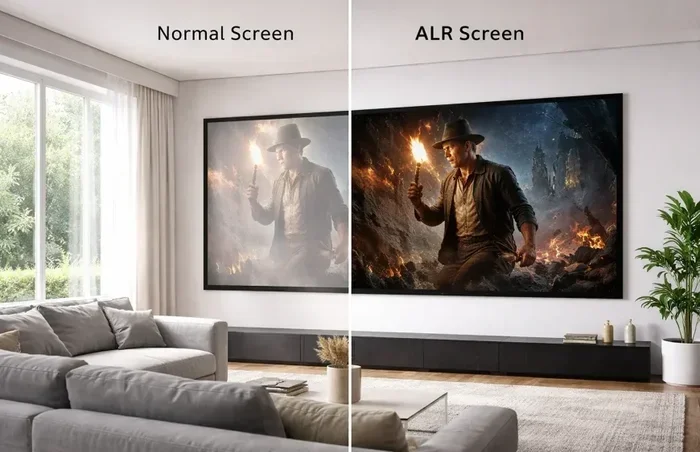
In a completely dark room, almost any white screen will work well. But in a brighter room, you need a screen that can reject ambient light and keep your image looking sharp. This is where specialized screens like ambient light rejecting (ALR) screens come into play.
ALR screens use a textured surface that reflects projector light directly toward the viewer while absorbing light from other directions. The result is a much clearer, more vibrant image even in a room with windows or overhead lights. These screens are more expensive, but they make a dramatic difference in bright environments.
If your projector setup includes a window, you might also want to read Can I Use Any Projector For Window for tips on managing light and choosing the right equipment.
Quick Tips for Dealing With Ambient Light
- Use curtains or blinds to block sunlight during movie time.
- Choose a gray or ALR screen for brighter rooms.
- Position your projector perpendicular to the screen to reduce glare.
- Turn off unnecessary lights in the room.
- Consider a high-gain screen if you cannot control the lighting.
Matching Your Screen to Your Projector Type
Different projectors need different screens to perform at their best. A budget projector paired with a high-end screen will still look better than a budget projector on a bedsheet, but the mismatch can hold back both devices. Matching them properly unlocks the full potential of your setup.
For 4K projectors, you need a screen with a very smooth surface. Any bumps or texture will be visible at that resolution. Look for screens labeled as 4K-compatible or ultra-smooth. For short-throw projectors, the screen needs to handle light that hits it at a steep angle. Specialized short-throw screens are designed for exactly this purpose.
If you are using an outdoor projector or a portable setup for events, a durable and weather-resistant screen is a must. Inflatable screens are popular for outdoor use because they are easy to set up and take down. They also provide a large, flat surface that works well for casual movie nights in the backyard.
Comparison Table: Screen Types at a Glance
| Screen Type | Best For | Handles Light Well? | Price Range |
|---|---|---|---|
| Matte White | Dark rooms, home theaters | Poor in bright rooms | Budget to mid-range |
| Gray | Mixed lighting rooms | Good | Mid-range |
| High-Gain | Large rooms, presentations | Excellent for brightness | Mid-range to premium |
| ALR (Ambient Light Rejecting) | Bright rooms with windows | Excellent | Premium |
| Portable/Inflatable | Outdoor events, camping | Fair to good | Budget to mid-range |
| DIY (Sheet/Curtain) | Budget setups, temporary use | Variable | Very low cost |
The table above shows that there is no single “best” screen. The right choice depends on your room, your projector, and how you plan to use it. Taking a few minutes to evaluate your setup before buying will save you money and disappointment.
Expert Insights: What Professionals Look For
AV professionals and home theater designers follow a few key principles when choosing projector screens. These insights can help you make a smarter decision, even if you are not a professional installer.
First, they always start with the room. The size of the room, the amount of ambient light, and the seating distance all determine the ideal screen size and type. Second, they match the screen gain to the projector brightness. A bright projector in a dark room does well with a low-gain screen. A dim projector in a bright room needs a high-gain screen to compensate.
Third, professionals pay close attention to screen texture. Even tiny imperfections become visible when projected at large sizes. They prefer screens with a uniform, smooth surface that does not create hotspots or uneven brightness. Fourth, they consider the viewing angle. Everyone in the room should see a bright, clear image, not just the person sitting dead center.
Finally, experts recommend investing in the screen as much as the projector. A great screen makes a good projector look even better. A poor screen can make an expensive projector look mediocre. Think of the screen as the final step in your image chain, and give it the attention it deserves.
Common Mistakes People Make When Choosing a Screen
Avoiding common mistakes can save you time, money, and frustration. Here are the biggest pitfalls to watch out for.
- Buying a screen that is too small. People often underestimate how big the screen should be for their room. A screen that is too small makes the experience feel flat and unimpressive.
- Ignoring ambient light. A white screen in a bright room will look terrible. Always consider the lighting conditions in your viewing space.
- Choosing based on price alone. The most expensive screen is not always the best for your situation. A budget screen that matches your room will outperform an expensive screen that does not.
- Forgetting about aspect ratio. A mismatched aspect ratio adds unwanted black bars and wastes part of your screen.
- Skipping the test. If possible, try before you buy. Many retailers let you test screens in-store, and some online sellers have generous return policies.
Final Thoughts
So, do different projector screens make a difference? The answer is a resounding yes. The screen you choose affects everything from image sharpness and color accuracy to brightness and contrast. Whether you are building a dedicated home theater, setting up a backyard movie night, or just want a better presentation setup, the right screen elevates the entire experience.
Take the time to understand your options. Consider your room lighting, your projector type, and how you will use the screen most often. A little research goes a long way toward finding the perfect setup. And remember, you do not need to spend a fortune to get great results. Even a well-chosen budget screen can deliver impressive picture quality.
The world of projector screens is more interesting and varied than most people realize. From matte white to high-gain, from fixed frames to inflatable setups, there is a screen out there for every need and budget. The key is knowing what matters and making an informed choice. Your eyes will thank you every time you sit down to watch.
Frequently Asked Questions
Do different projector screen materials really change picture quality?
Yes, they absolutely do. Different materials reflect light differently, which affects brightness, contrast, and color accuracy. A matte white screen gives natural colors, while a gray screen boosts contrast in bright rooms.
Can I use a white bedsheet as a projector screen?
You can, but the results will not be as good as a proper projector screen. Sheets often have wrinkles, texture, and color imperfections that show up in the projected image. A dedicated screen always delivers a cleaner picture.
What size projector screen do I need for my room?
The ideal size depends on your seating distance and room size. A common rule is that the screen should be about one-third the distance from the screen to your main seating position. This ensures a comfortable and immersive viewing experience.
Is a high-gain screen better than a matte white screen?
It depends on your situation. High-gain screens are brighter and work well in large or bright rooms, but they have a narrow viewing angle. Matte white screens offer wider viewing angles and more natural colors, making them better for dark home theaters.
Do I need an ambient light rejecting screen?
You need one if your room has a lot of windows or overhead lights. ALR screens are designed to reject ambient light and keep your image looking sharp and vibrant. In a completely dark room, a standard matte white screen works just fine.
Are portable projector screens worth buying?
Yes, portable screens are a great option for people who need flexibility. They are easy to set up, affordable, and have improved dramatically in quality. They are perfect for outdoor movie nights, camping trips, or presentations at different locations.
=== CONCLUSION ===
Choosing the right projector screen is one of the simplest ways to improve your viewing experience. Different projector screens make a real and noticeable difference in how your content looks, from sharpness and color to brightness and contrast. Whether you go with a sleek fixed screen, a versatile portable option, or a creative DIY solution, the key is matching the screen to your room and your projector.
Take the time to evaluate your setup, consider your lighting conditions, and pick a screen that fits your needs and budget. You will be amazed at how much better your movies, games, and presentations look with the right screen. The investment pays off every single time you hit play.