Do You Need External Speakers For Audio Technica Turntable
You do not always need external speakers for your Audio Technica turntable. Many models come with a built-in preamp and can connect directly to powered speakers or a stereo system. However, external speakers dramatically improve sound quality and let you enjoy the full warmth of vinyl. This guide walks you through every option so you can set up the best audio experience for your turntable.
This is a comprehensive guide about Do You Need External Speakers For Audio Technica Turntable.
Key Takeaways
- Some Audio Technica turntables have built-in speakers: You can play records right out of the box without any extra equipment.
- External speakers unlock better sound quality: They deliver richer, deeper audio that built-in speakers simply cannot match.
- You need a phono preamp for most setups: Some turntables include one, but others require a separate preamp to work with standard speakers.
- Multiple connection options exist: RCA cables, Bluetooth, and even auxiliary inputs give you flexibility in how you connect speakers.
- Speaker impedance matters: Matching your turntable to the right speaker impedance prevents damage and ensures optimal performance.
- Powered speakers are the easiest option: They have built-in amplifiers, so you skip extra gear and setup hassle.
[FEATURED_IMAGE_PLACEHOLDER]
Do You Need External Speakers For Audio Technica Turntable
If you just bought an Audio Technica turntable, you might be wondering whether you need extra speakers. The short answer is: it depends on what you want out of your listening experience. Some Audio Technica models come with built-in speakers that work fine for casual listening. But if you care about vinyl sound quality, external speakers make a huge difference.
This article breaks down everything you need to know. We will cover built-in vs. external options, how to connect speakers, and which setups give you the best record player audio. By the end, you will know exactly what equipment you need and why.
Let us start with the basics. An Audio Technica turntable is a precision instrument designed to read the grooves of a vinyl record and convert them into electrical signals. Those signals then need to be amplified and turned into sound. The question is simply: where does that sound come out?
Understanding Your Audio Technica Turntable Setup
Before you buy any speakers, you need to understand how your turntable works. Every turntable has a few key parts that affect audio output. Knowing these parts helps you make smarter buying decisions.
The Phono Preamp
The phono preamp is the most important piece of the puzzle. It takes the tiny electrical signal from the turntable stylus and amplifies it to line level. Without this amplification, your turntable speakers will produce almost no sound or sound distorted.
Some Audio Technica turntables have a built-in phono preamp. This means you can connect them directly to a stereo system or powered speakers without any extra gear. Other models do not include a preamp, which means you need an external one.
Here is how to tell if your turntable has a built-in preamp:
- Check the back panel for a PHONO/LINE switch.
- Look for a USB output, which often means a built-in preamp.
- Consult the user manual or product page on the Audio Technica website.
The Built-In Speaker Models
Audio Technica offers a few turntable models that come with built-in speakers. These are great for people who want a simple, all-in-one setup. You set the turntable on your desk or shelf, drop the needle, and listen.
However, built-in speakers have limitations. They are small, which means they cannot produce deep bass or rich highs. The sound can feel flat compared to what you get with a proper stereo system. If you are a casual listener who plays records occasionally, built-in speakers might be fine.
But if you are serious about vinyl sound quality, you will want to explore external speaker options. Trust us, your ears will thank you.
Why External Speakers Matter
External speakers transform your turntable from a simple playback device into a true audio experience. Here is why they matter so much.
Sound Quality Improvement
The biggest reason to add turntable speakers is sound quality. Built-in speakers are limited by their size and placement on the turntable. They cannot move enough air to produce full, rich sound.
External speakers are bigger and more powerful. They can reproduce the full frequency range of vinyl records. You will hear details in the music that you never noticed before. The warmth of analog sound comes alive when you use proper external speakers.
Here is what better speakers give you:
- Deeper bass: Low frequencies from drums and bass guitars sound full and present.
- Clearer highs: Cymbals, strings, and vocals sound crisp and detailed.
- Wider soundstage: You can hear the spatial positioning of instruments, just like being in the studio.
- Less distortion: External speakers handle volume better without distorting the audio.
The Listening Experience
Listening to vinyl on a good set of external speakers is a completely different experience. The music feels alive. You can hear the room ambiance, the breath of the singer, and the decay of each note. This is why people fall in love with vinyl in the first place.
Even if you are not an audiophile, the difference is easy to hear. Try playing the same record on built-in speakers and then on a pair of decent turntable speakers. You will immediately notice the improvement.
Types Of Speakers You Can Use
Not all speakers are the same, and not all work well with turntables. Here are the main types you should consider for your Audio Technica turntable setup.
Powered Speakers
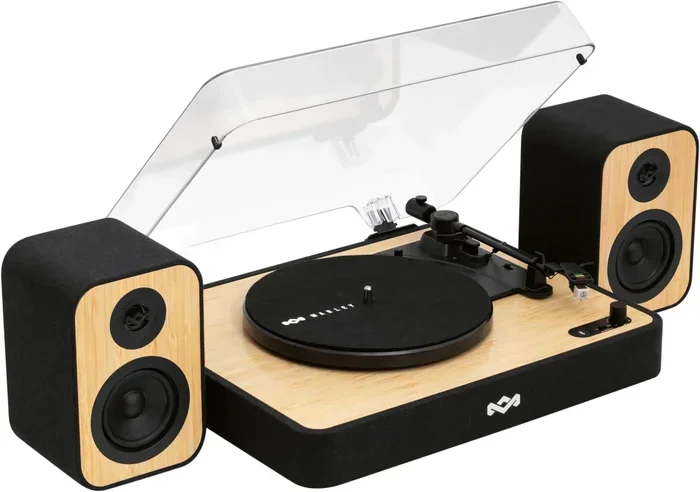
Powered speakers, also called active speakers, have a built-in amplifier. This means you can connect them directly to your turntable without needing a separate amplifier or receiver. They are the easiest option for most people.
Benefits of powered speakers include:
- No extra amplifier needed.
- Simple setup with just a cable.
- Compact designs that fit any room.
- Built-in volume controls for easy adjustment.
Many people wonder if they can plug speakers into their laptop and use similar setups for their turntable. The principle is similar, but turntables require a phono preamp, which adds an extra step.
Passive Speakers
Passive speakers do not have a built-in amplifier. You need a separate amplifier or receiver to power them. These speakers offer more flexibility and often better sound quality at higher price points.
With passive speakers, you connect the turntable to a phono preamp, then to an amplifier, and finally to the speakers. This chain gives you more control over your audio output. But it also means more equipment and more setup time.
Bluetooth Speakers
Bluetooth speakers offer wireless convenience. Some Audio Technica turntables have Bluetooth output, which lets you connect wirelessly to compatible speakers. This is a great option if you want to keep your setup simple and cable-free.
You might also wonder if you can use smart speakers like Alexa as your audio output. You can use Alexa as a Bluetooth speaker for your TV, and the same concept applies to turntables with Bluetooth capability.
Bookshelf Speakers vs. Floor-Standing Speakers
Bookshelf speakers are compact and fit on shelves or desks. They work well in small to medium rooms. Floor-standing speakers are larger and produce more powerful sound. They are better for bigger spaces and serious listening.
For most turntable setups, bookshelf speakers are a great starting point. They balance size, sound quality, and price well. Floor-standing speakers are ideal if you have the space and want the fullest possible sound.
How To Connect External Speakers To Your Turntable
Connecting speakers to your Audio Technica turntable is straightforward once you understand the basics. The method depends on your turntable model and the type of speakers you choose.
Direct Connection With Built-In Preamp
If your turntable has a built-in phono preamp and a LINE output, you can connect directly to powered speakers. Here is the step-by-step process:
- Set the turntable switch to LINE mode.
- Take the RCA cables from the turntable output.
- Connect the RCA cables to the input on your powered speakers.
- Turn on the speakers and adjust the volume.
- Drop the needle and enjoy your music.
This is the simplest setup. It requires no extra equipment and takes just a few minutes.
Connection With External Preamp
If your turntable does not have a built-in preamp, you need an external one. The connection chain looks like this:
- Connect the turntable output to the external phono preamp using RCA cables.
- Connect the preamp output to your amplifier or powered speakers.
- Power on all devices and adjust volume levels.
The external preamp ensures the signal is properly amplified before it reaches your speakers. Without it, the sound will be weak and thin.
Using an Amplifier or Receiver
If you use passive speakers, you need an amplifier or receiver in the chain. The amplifier takes the line-level signal and boosts it enough to power the speakers. This setup is more complex but offers the best sound quality.
A good amplifier also gives you multiple inputs. You can connect your turntable, a CD player, and a streaming device all to the same system. This turns your listening area into a full stereo system.
Common Audio Connection Options
Turntables offer several ways to connect to speakers and other audio equipment. Understanding these options helps you choose the right setup.
RCA Connections
RCA cables are the standard connection for turntables. They use red and white (or red and black) plugs for right and left audio channels. Most turntables, preamps, amplifiers, and powered speakers use RCA inputs.
RCA connections are reliable and carry good quality audio. They are the go-to choice for most turntable setups.
Auxiliary (3.5mm) Connections
Some turntables and speakers offer a 3.5mm auxiliary input. This is a simple jack connection, similar to what you find on headphones. It is convenient for quick setups but may not deliver the best audio quality compared to RCA.
Bluetooth Wireless Connections
Bluetooth eliminates the need for cables. If your turntable has Bluetooth output, you can pair it with any compatible speaker within range. This is great for flexibility, but keep in mind that wireless connections can sometimes introduce slight audio latency or compression.
If you are dealing with audio cables and connections, you might find it interesting that converting HDMI to RCA for audio involves similar principles of connecting different audio formats together.
USB Digital Output
Some modern Audio Technica turntables include a USB output for digital recording. This output is not meant for connecting to speakers directly. Instead, it sends the audio signal to a computer for recording or playback through digital speakers or headphones.
Speaker Impedance And Matching
One thing many people overlook is speaker impedance. This is measured in ohms and tells you how much power a speaker can handle. Matching your speakers to your turntable setup is important for both sound quality and equipment safety.
Most powered speakers have an impedance of 4 to 8 ohms. This works well with most turntable setups. If you are using passive speakers with an amplifier, make sure the amplifier can handle the speaker impedance.
Using speakers with the wrong impedance can cause problems:
- Too low impedance: Can overwork the amplifier and cause overheating.
- Too high impedance: Results in weak, quiet sound.
- Mismatched impedance: Can damage your equipment over time.
Always check the specifications of both your turntable and your speakers before making a connection. This simple step saves you from costly mistakes.
Quick Tips For The Best Turntable Audio Setup
Here are some practical tips to get the most out of your Audio Technica turntable and speaker setup:
- Place your turntable on a stable, level surface. Vibrations can cause unwanted noise and distortion.
- Keep speakers at ear level when seated. This positioning gives the best stereo imaging.
- Use high-quality RCA cables. Cheap cables can introduce static and signal loss.
- Break in your speakers. Like vinyl records, speakers sound better after some use. Give them at least 20-30 hours of playtime.
- Experiment with speaker placement. Even small adjustments can make a big difference in sound quality.
- Keep your turntable clean. Dust on the stylus and records degrades audio quality fast.
- Start simple. A basic powered speaker setup is all you need to get started. You can always upgrade later.
Common Mistakes To Avoid
Setting up a turntable and speaker system is fun, but there are some common pitfalls. Avoid these mistakes to protect your equipment and get the best sound.
Skipping the phono preamp. This is the number one mistake beginners make. Without a preamp, your speakers will barely produce any sound, and the audio will sound wrong. Always check whether your turntable has a built-in preamp before connecting to speakers.
Connecting to the wrong input. Plugging your turntable into a line-level input without a preamp (or into a phono input with a built-in preamp) will cause problems. Make sure you match the output to the correct input type.
Overpowering your speakers. Running too much volume through small speakers can blow them out. Start at a low volume and gradually increase to find the sweet spot.
Ignoring room acoustics. Even the best turntable speakers sound bad in a room with poor acoustics. Hard surfaces cause echo, and corners create bass buildup. Try adding rugs, curtains, or bookshelves to improve your room sound.
Expert Insights On Turntable Audio
Audio engineers and vinyl enthusiasts agree on one thing: the speaker setup makes or breaks the turntable experience. A great turntable paired with mediocre speakers will never sound its best. But a good turntable with quality external speakers can deliver an incredibly rewarding listening experience.
Many experts recommend starting with a pair of powered bookshelf speakers. They are affordable, easy to set up, and deliver surprisingly good sound. From there, you can upgrade to better speakers, add a quality amplifier, or build a full stereo system as your passion for vinyl grows.
The beauty of the Audio Technica turntable line is its versatility. Whether you are a beginner or a seasoned collector, there is a setup that works for you. You do not need to spend a fortune to enjoy great record player audio. Start with what you have, and build from there.
Conclusion
So, do you need external speakers for your Audio Technica turntable? Not strictly, but you really should if you want to hear your records the way they were meant to sound. Built-in speakers work for casual listening, but external speakers bring the music to life in a way that is hard to describe until you hear it yourself.
Whether you choose powered speakers for simplicity or passive speakers with a dedicated amplifier for maximum control, the upgrade is worth it. Focus on getting a proper phono preamp, use quality cables, and take the time to position your speakers well.
Your vinyl collection deserves the best possible audio. Start with the basics, experiment as you go, and enjoy the journey of discovering your perfect turntable setup. The warmth and richness of vinyl sound on good speakers is an experience you will never want to go back from.
Frequently Asked Questions
Can I Use Any Speakers With My Audio Technica Turntable?
Most speakers work with an Audio Technica turntable as long as you have the right connection and a phono preamp. Powered speakers with RCA input are the easiest option. Passive speakers need a separate amplifier. Always check that your speaker impedance matches your setup to avoid damage.
Do All Audio Technica Turntables Have Built-In Speakers?
No, not all Audio Technica turntables have built-in speakers. Some entry-level models do include them for convenience. But most Audio Technica turntables are designed for external speaker setups. Check your specific model to see what is included.
What Is The Difference Between A Phono Preamp And A Line-Level Preamp?
A phono preamp amplifies the tiny signal from the turntable stylus to line level. A line-level preamp takes an already-amplified signal and adjusts it. Some Audio Technica turntables have a switch that lets you toggle between PHONO and LINE modes, which controls whether the built-in preamp is active.
Can I Connect My Turntable To A Computer Speaker System?
Yes, you can connect your turntable to a computer speaker system if it has the right inputs. Many powered computer speakers use a 3.5mm aux input, which works with a turntable that has a 3.5mm output or an RCA-to-3.5mm adapter. Just make sure you use a phono preamp if your turntable does not have a built-in one.
How Many Speakers Do I Need For My Turntable?
For stereo sound, you need two speakers. A stereo setup gives you the spatial imaging that vinyl records are mastered to deliver. You can start with a pair of bookshelf speakers and add more later if you want a surround or multi-room setup.
Is Bluetooth Sound Quality Good Enough For Vinyl Listening?
Bluetooth sound quality has improved a lot, but it still uses audio compression that can slightly reduce the detail of vinyl records. For the best vinyl sound quality, a wired connection through RCA cables is always preferable. Use Bluetooth only when convenience matters more than absolute audio fidelity.
Frequently Asked Questions
What is Do You Need External Speakers For Audio Technica Turntable?
Do You Need External Speakers For Audio Technica Turntable is an important topic with many practical applications.