10 Key Differences Between Analog and Digital Computers
Analog and digital computers process information in fundamentally different ways. Analog machines use continuous physical signals for real-time processing, while digital machines use discrete binary values for precision and versatility. Understanding these 10 key differences helps you appreciate how both types of computing have shaped the technology we use every day.
Have you ever wondered how the computers we use today are different from the machines that came decades ago? The world of computing has evolved tremendously, and understanding analog and digital computers is a great way to appreciate that journey.
These two types of machines handle information in fundamentally different ways. One uses continuous physical signals, while the other relies on discrete binary values. Both have played important roles in shaping the technology we use every single day.
In this article, we will walk through 10 key differences between analog and digital computers. You will learn how each type works, where they excel, and why modern technology mostly relies on one over the other. By the end, you will have a clear and practical understanding of both computing worlds.
Key Takeaways
- Data Representation: Analog computers use continuous signals while digital computers use discrete binary values, which fundamentally shapes how each machine processes information.
- Precision and Reliability: Digital computers offer higher computational accuracy and built-in error correction, making them more reliable for most tasks.
- Real-Time Processing: Analog computers excel at real-time signal processing and continuous system control, where speed matters more than precision.
- Programmability: Digital computers are highly programmable and versatile, while analog computers are typically hardwired for specific functions.
- Modern Dominance: Digital computing dominates the modern world, but analog technology remains relevant in specialized applications and hybrid systems.
- Future Outlook: The future of computing technology will likely blend both approaches, with neuromorphic and analog-inspired chips complementing digital systems.
- Understanding Both Matters: Knowing the differences between analog and digital computers gives you a stronger foundation for understanding how modern technology works.
📑 Table of Contents
What Are Analog and Digital Computers?
Before we jump into the differences, let us first understand what each type of computer actually is. Both analog and digital computers are tools for processing information, but they go about it in very different ways.
A Closer Look at Analog Computers
An analog computer works with continuous signals. Think of it like a dimmer switch on a light. You can set it to any level between fully off and fully on. The machine represents data using physical quantities such as voltage, current, or mechanical movement.
These machines were hugely popular in the mid-20th century. Scientists and engineers relied on them for complex calculations. They could solve differential equations in real time, which made them invaluable for tasks like flight simulation and weather modeling.
One famous example is the differential analyzer, built in the 1930s. It used spinning discs and gears to perform mathematical operations. Another important example is the operational amplifier, which uses electrical circuits to model mathematical functions. These devices showed that computing did not have to be digital to be powerful.
A Closer Look at Digital Computers
A digital computer works with discrete values. It uses the binary system, meaning everything is represented as either a 0 or a 1. These machines process data as numbers and execute instructions step by step.
Today, almost every computer you touch is a digital machine. Your smartphone, laptop, and even smart home devices all use digital computing. They store data in bits and bytes, and they process information through logic gates and binary logic.
Digital computers are incredibly flexible. You can program them to do almost anything. From simple word processing to complex video editing, they handle a wide range of tasks with remarkable ease. This flexibility is one of the main reasons digital computers took over the world.
How They Process Data Differently
Continuous vs Discrete Signals
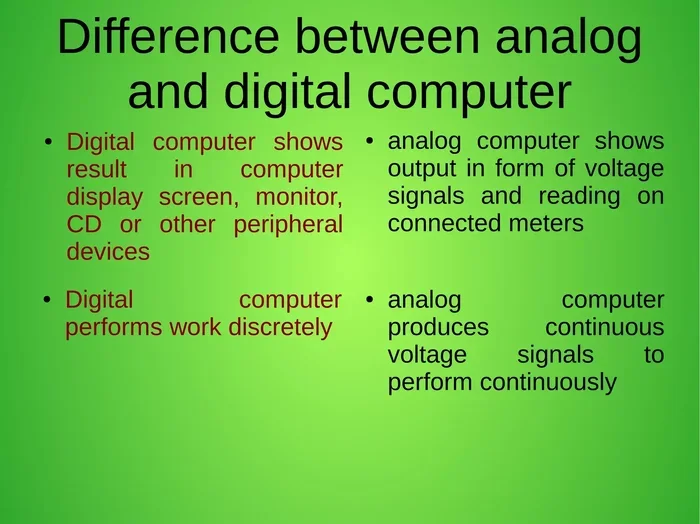
The biggest difference between these two types of machines lies in how they represent data. Analog computers use continuous signals. The value can change smoothly over time, just like the temperature outside. A digital computer uses discrete signals. The value jumps from one step to the next, like the numbers on a clock.
Imagine drawing a smooth curve on a piece of paper. That smooth line represents an analog signal. Now imagine drawing the same curve using small dots. The more dots you use, the closer it looks like the smooth curve. That is essentially how digital signal processing works. It approximates continuous values using discrete steps.
Signal Processing Methods
Analog signal processing happens in real time. The machine responds immediately to changes in input. There is no need to convert data first. This makes analog systems very fast for certain types of tasks, especially in control systems and instrumentation.
Digital signal processing works by sampling data at regular intervals. The computer takes snapshots of the signal and processes them one by one. This method allows for high computational accuracy and easy storage. It also makes error correction possible, which analog systems struggle with.
Data Representation and Memory
When it comes to data representation, analog computers use physical properties. A voltage level might represent a number. A gear position might represent a speed. Digital computers, on the other hand, encode everything as binary numbers stored in memory storage units.
This difference has huge implications. Analog data can degrade over time due to noise and physical wear. Digital data can be copied perfectly and stored indefinitely. This is why digital computing dominates modern computing technology.
10 Key Differences Between Analog and Digital Computers
Now let us get to the heart of the article. Here are 10 key differences between analog and digital computers that every tech enthusiast should understand.
| Feature | Analog Computer | Digital Computer |
|---|---|---|
| Data Type | Continuous signals | Discrete binary values |
| Precision | Limited by physical components | Very high, limited by bit depth |
| Processing Speed | Real-time, fast for specific tasks | Extremely fast for general tasks |
| Memory | No long-term storage | Extensive storage capabilities |
| Programmability | Hardwired, difficult to reconfigure | Highly programmable and flexible |
| Error Handling | Prone to noise and drift | Built-in error detection and correction |
| Size | Often large and complex | Can be very compact |
| Cost | Expensive for specialized tasks | Affordable and widely available |
| Output | Graphs, physical measurements | Text, images, sound, video |
| Use Cases | Scientific instruments, control systems | General purpose, almost everything |
That table gives you a quick snapshot. Now let us go deeper into each difference.
- Data Representation. Analog computers represent data as continuous physical quantities. A voltage level or a mechanical position stands for a value. Digital computers represent data as binary numbers. Every piece of information is broken down into 0s and 1s.
- Precision and Accuracy. Analog computing has inherent limitations. Physical components like resistors and capacitors are never perfectly accurate. Small changes in temperature or age can shift results. Digital computers offer much higher computational accuracy. They can represent numbers to many decimal places, limited mainly by the number of bits used.
- Processing Speed. For specific tasks like solving differential equations, analog computers can be incredibly fast. They process data in real time without needing to convert it first. Digital computers are also fast, but they process data in steps. However, modern digital machines are so fast that this difference matters less and less today.
- Memory and Storage. Analog computers generally lack long-term memory. They store data in physical states that disappear when power is removed. Digital computers have vast memory storage capabilities. You can save files, programs, and entire operating systems for years without any loss.
- Programmability. This is a major advantage for digital computers. You can reprogram them to do completely different tasks with a few clicks. Analog computers are typically hardwired for specific functions. Changing what they do requires physical reconfiguration, which is time-consuming and complex.
- Input and Output Methods. Analog computers often use physical inputs like knobs and dials. Their outputs are usually graphs drawn on paper or physical meter readings. Digital computers support a wide range of inputs, from keyboards to touchscreens. Their outputs include text, images, video, and sound.
- Error Handling. Analog systems are vulnerable to noise and signal drift. External interference can corrupt results, and there is often no way to detect or fix these errors. Digital systems have built-in error correction mechanisms. They can detect and fix corrupted data, making them far more reliable.
- Physical Size and Complexity. Early analog computers were often large and complicated. They required many physical components like gears, levers, and vacuum tubes. Modern digital computers can fit on a tabletop or even in your pocket. Advances in electronic computer design have made them incredibly compact.
- Cost and Accessibility. Analog computing equipment was expensive and specialized. It was mostly used by research labs and large corporations. Digital computers have become affordable and accessible to billions of people worldwide. You probably carry one in your pocket right now.
- Versatility. Analog computers excel at specific types of problems, particularly those involving continuous systems. Digital computers are general-purpose machines. They can handle everything from browsing the web to running complex scientific simulations. This versatility is why digital computing dominates the modern world.
Real-World Applications and Use Cases
Where Analog Computers Still Matter
You might think analog computers are a thing of the past, but that is not entirely true. They still play important roles in certain fields. For example, analog signal processing is used in audio equipment. Guitar amplifiers and mixing boards rely on continuous electrical signals to shape sound.
Industrial control systems also use analog principles. Temperature controllers in manufacturing plants often work with continuous sensor readings. Some medical devices, like certain types of heart monitors, use analog circuits to track vital signs in real time.
In some cases, a hybrid computer combines both analog and digital elements. These machines get the best of both worlds. They use analog components for fast, real-time processing and digital components for precision and storage. Hybrid systems are used in specialized fields like medical imaging and industrial automation.
Where Digital Computers Dominate
Digital computers have taken over almost every field you can think of. From education to entertainment, from healthcare to finance, digital computing is everywhere.
In science, digital machines run simulations that would take analog computers years to complete. In business, they manage databases, process transactions, and run entire operations. In our personal lives, they power our phones, tablets, smart TVs, and even our cars.
The rise of modern computing has been driven almost entirely by digital technology. The binary system and logic gates that power digital computers have enabled incredible advances in artificial intelligence, cloud computing, and the internet of things.
Expert Insights and Common Mistakes
Quick Tips for Understanding the Differences
- Think of analog as a smooth curve and digital as a series of steps. This mental model helps you grasp the core difference quickly.
- Remember that analog does not mean outdated. Analog technology is still very much alive in specific applications where real-time processing matters.
- Focus on precision. If your task demands exact numbers, digital is the way to go. If your task needs real-time response to continuous change, analog has an edge.
- Consider hybrid systems. Many modern devices blend both approaches. Understanding both gives you a fuller picture of how technology works.
Common Mistakes People Make
- Assuming analog computers are obsolete. While they are rare in general computing, they still serve critical roles in specialized fields like signal processing and control systems.
- Thinking digital always means better. Digital is more versatile and precise, but analog can be faster for specific real-time tasks. The best choice depends on the application.
- Confusing speed with versatility. Analog computers can be very fast at one thing. Digital computers are fast at almost everything. These are different strengths.
- Ignoring the role of noise. Analog systems are sensitive to electrical noise, which can degrade accuracy. Digital systems are much more resilient to this problem.
Expert Insight
According to computing historians, the shift from analog to digital was not instantaneous. It happened gradually over several decades. Early electronic computers like ENIAC were digital, but many scientific instruments continued to use analog methods well into the 1980s. The real turning point came when digital storage and microprocessors became cheap enough to replace analog systems across the board.
Today, the conversation is not really about analog vs digital. It is about understanding how both approaches complement each other. Many cutting-edge fields, like neural network hardware, are revisiting analog principles to achieve faster and more energy-efficient computing technology.
The Future of Computing Technology
So what does the future hold for these two types of machines? Interestingly, researchers are finding new reasons to revisit analog computing. As digital computers approach their physical limits in terms of size and energy use, analog and neuromorphic chips offer promising alternatives.
Neuromorphic computing, for instance, mimics the human brain. It uses continuous electrical signals to process information, much like an analog computer. This approach could lead to computers that are dramatically more efficient at tasks like image recognition and natural language processing.
At the same time, digital computing continues to advance. Quantum computing, while still in its early stages, promises to solve problems that no current machine can handle. The future will likely see a blend of technologies, with digital and analog methods working together to push the boundaries of what computers can do.
The key takeaway is simple. Understanding the differences between analog and digital computers gives you a stronger foundation for thinking about where technology is headed. Both approaches have unique strengths, and the best innovations often come from combining them.
Conclusion
The world of computing is fascinating, and the differences between analog and digital computers tell an important story. From the smooth, continuous signals of analog machines to the precise binary logic of digital systems, each type has shaped the technology we rely on today.
We covered 10 key differences between analog and digital computers, from data representation and precision to programmability and real-world applications. We also explored where each type still matters and what the future might hold.
Whether you are a student, a tech enthusiast, or simply curious about how things work, understanding these differences gives you valuable insight into the foundation of modern computing technology. The next time you use a computer, take a moment to appreciate the incredible journey from analog signals to digital brilliance.
Analog and digital computers each have their place in history and in the present. By knowing their strengths and weaknesses, you can better understand the technology that shapes our world every day.
Frequently Asked Questions
What is the main difference between analog and digital computers?
The main difference is how they represent data. Analog computers use continuous physical signals like voltage or mechanical movement. Digital computers use discrete binary values of 0s and 1s. This fundamental difference affects everything from precision to programmability.
Are analog computers still used today?
Yes, but in limited and specialized applications. Analog principles are still used in audio equipment, industrial control systems, and certain medical devices. Some modern systems also use hybrid approaches that combine analog speed with digital precision for the best of both worlds.
Why did digital computers replace analog computers?
Digital computers won out because they are more versatile, precise, and reliable. They can be reprogrammed for different tasks, they offer built-in error correction, and they store data without degradation. As digital technology became cheaper and more powerful, analog systems were gradually replaced in most applications.
Can analog computers be more accurate than digital computers?
In general, digital computers are more accurate because they can represent numbers to many decimal places. However, for specific real-time tasks, analog computers can be more accurate because they process data continuously without sampling delays. The accuracy depends on the application and the quality of the components used.
What is a hybrid computer?
A hybrid computer combines analog and digital components. It uses analog parts for fast, real-time processing of continuous signals and digital parts for precision, storage, and programmability. Hybrid systems are used in specialized fields like medical imaging and industrial automation where both speed and accuracy matter.
What role does the binary system play in digital computers?
The binary system is the foundation of all digital computing. It uses only two values, 0 and 1, to represent all data and instructions. This simplicity makes digital systems reliable and easy to build using electronic switches called logic gates. Every operation in a digital computer ultimately comes down to binary calculations.
=== URL SLUG ===
10-key-differences-between-analog-and-digital-computers
=== SEO TITLE ===
10 Key Differences Between Analog and Digital Computers
=== META TITLE ===
10 Key Differences Between Analog and Digital Computers