Did Hedy Lamarr Really Invent Wi Fi The Truth Revealed
Did Hedy Lamarr really invent Wi-Fi? The answer is more nuanced than a simple yes or no. Hedy Lamarr co-invented frequency hopping spread spectrum technology during World War II, which became a foundational building block for Wi-Fi, Bluetooth, and GPS. While she didn’t invent Wi-Fi directly, her patented invention paved the way for modern wireless communication.
Most people know Hedy Lamarr as a glamorous Hollywood actress from the golden age of cinema. She starred in films like Algiers and Boom Town. But there is a fascinating side to her story that many people overlook. Hedy Lamarr was also an inventor. And her invention might surprise you.
Did Hedy Lamarr really invent Wi-Fi? That is a question that has sparked countless debates online. The short answer is no, she did not invent Wi-Fi directly. But the long answer is much more interesting. Her work laid essential groundwork for wireless technology that we use every single day. Let us dive into the full story and separate fact from fiction.
The truth about Hedy Lamarr and Wi-Fi is a story of creativity, secrecy, and long-overdue recognition. Her journey from a Hollywood star to a recognized inventor is genuinely remarkable. So let us unpack everything you need to know about this incredible chapter in tech history.
Key Takeaways
- Hedy Lamarr was a real inventor: She co-created a secret communication system with composer George Antheil during WWII.
- Frequency hopping is the core idea: Her patent described a method to prevent signal jamming by rapidly switching frequencies.
- Wi-Fi was not directly invented by Lamarr: Modern Wi-Fi evolved from her concept over decades of engineering work by many others.
- Her patent was ahead of its time: The Navy dismissed it during WWII, but it later became hugely influential.
- Lamarr received posthumous recognition: She was inducted into the National Inventors Hall of Fame and received the Electronic Frontier Foundation Pioneer Award.
- Her legacy extends beyond Wi-Fi: Bluetooth, GPS, and modern cellular networks all trace roots to her frequency hopping concept.
- The truth is complicated: Lamarr contributed a key idea, but Wi-Fi as we know it required many other inventors and engineers.
📑 Table of Contents
- Who Was Hedy Lamarr?
- The Real Story Behind Hedy Lamarr and Wi-Fi
- Did Hedy Lamarr Really Invent Wi-Fi? The Full Truth
- The Frequency Hopping Concept Explained Simply
- How Hedy Lamarr’s Patent Changed Technology Forever
- Why Hedy Lamarr’s Story Matters Today
- Common Myths About Hedy Lamarr and Wi-Fi
- Quick Tips: Understanding the Difference Between Invention and Innovation
- Expert Insights on Lamarr’s Legacy
- Conclusion
Who Was Hedy Lamarr?
Hedy Lamarr was born Hedwig Eva Maria Kiesler in Vienna, Austria, in 1914. She grew up in a Jewish family and showed an early curiosity about how things worked. Her father, a bank director, encouraged her to observe the world around her. She would often take long walks and think about machines and processes.
Lamarr started her acting career in Austria. Her first film, Ecstasy (1933), gained international attention. She later fled Europe as the Nazis rose to power. She arrived in America and signed with MGM Studios. Hollywood quickly fell in love with her beauty and talent. She became one of the biggest stars of the 1940s.
But Lamarr was not just a pretty face. She was deeply intelligent and endlessly curious. During her free time on movie sets, she would tinker with inventions. She designed a brighter glow-in-the-dark streetlight and a new type of drink tablet. Her most famous invention, however, came from a very different place. It came from wartime necessity.
A Mind Ahead of Her Time
Lamarr’s inventive mind was not a hobby. It was a genuine passion. She read scientific journals. She discussed engineering concepts with friends. She saw problems in everyday life and imagined solutions. This mindset would eventually lead her to one of the most important inventions in wireless communication history.
The Real Story Behind Hedy Lamarr and Wi-Fi
So where does Wi-Fi fit into Hedy Lamarr’s story? To understand this, we need to go back to the early 1940s. World War II was raging across Europe and the Pacific. Lamarr was married to Fritz Mandl, an Austrian arms manufacturer. She attended business meetings with weapons engineers and military strategists.
At these meetings, she learned about a serious problem. The Nazis were using radio-controlled torpedoes. These torpedoes could be guided to hit enemy ships. But there was a weakness. The radio signal controlling the torpedo could be intercepted or jammed. If an enemy could jam the signal, the torpedo would go off course.
Lamarr saw an opportunity to solve this problem. She wanted to create a communication system that could not be easily jammed or intercepted. This idea became the foundation of her most famous invention.
The Problem of Signal Jamming
Signal jamming was a huge concern during World War II. If an enemy could block or disrupt radio signals, communications would break down. Weapons systems would fail. Ships and submarines would be vulnerable. Finding a way to protect wireless signals was a top priority for the Allied forces.
Lamarr’s idea was simple in concept but brilliant in execution. She proposed changing the frequency of the radio signal rapidly and randomly. Both the sender and the receiver would hop between frequencies in a synchronized pattern. If an enemy tried to jam the signal, they would only block one frequency at a time. The rest of the signal would get through.
This concept is now known as frequency hopping spread spectrum. It is the same basic principle that underlies modern Wi-Fi technology, Bluetooth connections, and GPS systems.
Did Hedy Lamarr Really Invent Wi-Fi? The Full Truth
Now let us address the big question directly. Did Hedy Lamarr really invent Wi-Fi? The honest answer is no. But that answer does not tell the whole story.
Lamarr did not sit down and write the code that makes Wi-Fi work. She did not design the wireless routers we use in our homes today. What she did was invent a core technology concept that made modern wireless communication possible. Think of it this way. She did not build the house. But she invented a key brick that made the house possible.
Wi-Fi as we know it today was developed over many decades by many different engineers and companies. The IEEE 802.11 standard, which defines Wi-Fi, was created in the late 1990s. It built upon decades of research in wireless networking. Lamarr’s frequency hopping concept was one of many foundational ideas that contributed to this development.
What Lamarr Actually Invented
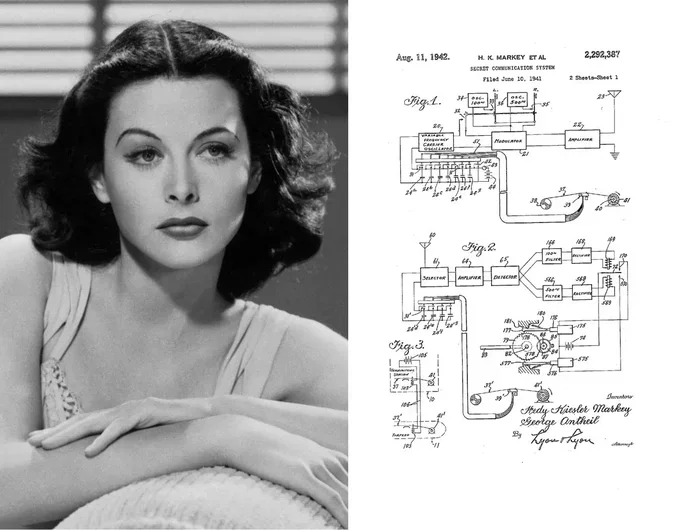
Hedy Lamarr co-invented a secret communication system. She patented it on June 10, 1942, along with composer George Antheil. Their patent was called “Secret Communication System.” It described a method for frequency-hopped signal transmission across 88 different frequencies. The number 88 came from the number of keys on a piano, which Antheil incorporated into the design using a player piano mechanism.
The patent was granted by the United States Patent Office. It was a genuine, legally recognized invention. However, the U.S. Navy did not adopt it during the war. They dismissed it as too difficult to implement practically. The idea was ahead of the technology available at the time.
It was not until decades later that frequency hopping became widely used. By then, Lamarr’s contribution had largely been forgotten by the public. But the technology community never forgot her.
Lamarr’s Role vs. Wi-Fi’s Actual Creators
To be fair about this topic, we need to distinguish between Lamarr’s contribution and the actual creation of Wi-Fi. Lamarr provided the foundational concept of frequency hopping. Wi-Fi was created by a team of engineers working on the IEEE 802.11 protocol. Key figures include NCR Corporation and AT&T researchers who developed the first Wi-Fi products in the 1990s.
The Wi-Fi Alliance, formed in 1999, commercialized the technology. Companies like Cisco, Apple, and Intel helped make Wi-Fi a household standard. Lamarr’s idea was one important piece of the puzzle, but the full picture required many contributors.
| Aspect | Hedy Lamarr’s Contribution | Wi-Fi Development |
|---|---|---|
| Time Period | 1940s | 1990s |
| Core Idea | Frequency hopping spread spectrum | Wireless local area networking |
| Purpose | Prevent torpedo signal jamming | Wireless internet access |
| Patent | U.S. Patent 2,292,387 | IEEE 802.11 standards |
| Direct Connection to Wi-Fi | Foundational concept | Direct creation |
| Recognized During Lifetime | No | Yes (by the tech industry) |
The Frequency Hopping Concept Explained Simply
Let us break down frequency hopping in plain language. Imagine you and a friend want to talk privately on a walkie-talkie. But there is a nosy neighbor who keeps listening in. What do you do?
You could switch channels every few seconds. You and your friend agree on a pattern. Channel 1, then channel 5, then channel 3, and so on. The nosy neighbor cannot follow you because they do not know the pattern. Your conversation stays private.
That is essentially what Lamarr and Antheil proposed. Their system would rapidly switch radio frequencies according to a predetermined sequence. The sender and receiver would stay synchronized. Anyone trying to intercept or jam the signal would fail.
How This Connects to Modern Wireless Tech
Today, frequency hopping is used in many forms of wireless communication. Bluetooth uses frequency hopping to connect your phone to headphones or speakers. GPS systems rely on spread spectrum signals to provide accurate location data. Cellular networks use similar concepts to manage millions of connections simultaneously.
Modern Wi-Fi networks use a related technique called direct sequence spread spectrum. While not identical to Lamarr’s original frequency hopping method, the underlying principle is the same. Spreading signals across multiple frequencies makes wireless communication more secure and resistant to interference.
So while Lamarr did not invent Wi-Fi directly, her concept is woven into the fabric of every wireless signal we use today. That is a remarkable legacy for any inventor, let alone a Hollywood actress.
How Hedy Lamarr’s Patent Changed Technology Forever
Lamarr’s patent sat unused for decades. The U.S. Navy classified it and moved on. But the idea lived on in the world of academic research and defense technology. By the 1960s, frequency hopping was being explored for military communications. By the 1980s, it was being adapted for civilian use.
The rise of personal computing in the 1990s created a demand for wireless connectivity. Engineers looked back at older patents and research for inspiration. Lamarr’s frequency hopping concept was rediscovered and recognized as a pioneering idea. Her patent became a reference point in the development of wireless standards.
The Road to Modern Wi-Fi
The journey from Lamarr’s patent to modern Wi-Fi was long and collaborative. Here is a simplified timeline of how her idea evolved:
- 1942: Lamarr and Antheil patent the frequency hopping system.
- 1950s-1960s: Military researchers explore spread spectrum for secure communications.
- 1970s-1980s: Civilian researchers begin adapting spread spectrum for commercial use.
- 1991: NCR Corporation and AT&T develop the first wireless Ethernet system.
- 1997: The IEEE releases the 802.11 standard, the foundation of Wi-Fi.
- 1999: The Wi-Fi Alliance is formed and the Wi-Fi brand is launched.
- 2000s-Present: Wi-Fi becomes ubiquitous in homes, offices, and public spaces worldwide.
Every step in this timeline built upon earlier work. Lamarr’s contribution was the spark that started a chain reaction of innovation. Without her idea, the path to Wi-Fi might have looked very different.
Other Technologies Born from Her Idea
Wi-Fi is not the only technology that traces back to Lamarr’s invention. Bluetooth uses frequency hopping to manage short-range wireless connections. GPS navigation relies on spread spectrum signals to transmit location data accurately. Even some cellular networks use variations of her concept.
The reach of her invention extends far beyond what most people realize. Every time you connect to a wireless network, pair Bluetooth headphones, or use a GPS navigation app, you are benefiting from an idea that Hedy Lamarr helped create.
Why Hedy Lamarr’s Story Matters Today
Hedy Lamarr’s story is more than just a tech history lesson. It is a story about recognition, gender bias, and the way society values innovation. For decades, Lamarr was known primarily as a movie star. Her contributions to science and technology were overlooked or dismissed.
In recent years, that has changed. Lamarr has received numerous posthumous honors. She was inducted into the National Inventors Hall of Fame in 2014. She received the Electronic Frontier Foundation Pioneer Award in 1997. Google even featured a doodle on her 101st birthday in 2015.
A Symbol of Overlooked Inventors
Lamarr’s story highlights a broader issue. Many inventors throughout history have been overlooked because of their background, gender, or circumstances. Lamarr was a woman working in a male-dominated field. She was also an actress, and some people dismissed her invention because of her Hollywood career.
Her experience reminds us that innovation can come from anywhere. It does not matter where you come from or what you do for a living. A curious mind and a willingness to solve problems can lead to world-changing ideas.
Today, Hedy Lamarr is celebrated as a role model for aspiring inventors everywhere. Her story inspires young women and girls to pursue careers in science, technology, engineering, and mathematics. She proves that creativity and technical thinking are not limited by profession or background.
Common Myths About Hedy Lamarr and Wi-Fi
There are several myths floating around about Hedy Lamarr and her connection to Wi-Fi. Let us address the most common ones.
- Myth 1: Lamarr invented Wi-Fi. She did not invent Wi-Fi. She invented a foundational concept that contributed to wireless technology.
- Myth 2: Her invention was used during World War II. The U.S. Navy rejected her patent during the war. It was never used for torpedo guidance.
- Myth 3: She worked alone on the invention. She co-invented the system with George Antheil. Both contributed essential elements.
- Myth 4: Wi-Fi is a direct copy of her patent. Modern Wi-Fi uses different techniques and standards. But the core idea of spread spectrum traces back to her work.
- Myth 5: Lamarr was not a real inventor. She held a legitimate patent. She was a genuine inventor with a real contribution to technology.
Quick Tips: Understanding the Difference Between Invention and Innovation
Hedy Lamarr’s story teaches us an important lesson about the difference between invention and innovation. Here are some quick tips to help you understand this distinction.
- Invention is creating something new for the first time. Lamarr invented frequency hopping.
- Innovation is improving or applying an invention to create practical value. Wi-Fi engineers innovated on Lamarr’s concept.
- Both matter. Without invention, there is nothing to innovate on. Without innovation, inventions stay unused.
- Recognition is not always fair. Some inventors get credit immediately. Others, like Lamarr, wait decades.
- Every technology has many contributors. No single person builds a complex technology alone.
Expert Insights on Lamarr’s Legacy
Technology historians and wireless engineering experts consistently praise Lamarr’s contribution. Dr. Mark Stewart, a telecommunications historian, has noted that her frequency hopping concept was decades ahead of its time. He emphasizes that while Wi-Fi was not her direct creation, her patent provided a conceptual foundation that influenced later researchers.
Professor Suzanne Wasserman of the Gotham Center for History has written about how Lamarr’s story challenges traditional narratives about who can be an inventor. Her background in Hollywood did not disqualify her from making meaningful contributions to science.
Wireless engineers today acknowledge that modern spread spectrum techniques owe a debt to Lamarr’s original vision. Her idea of rapid frequency switching remains a core principle in wireless communication design.
Conclusion
So did Hedy Lamarr really invent Wi-Fi? The truth is nuanced. She did not invent Wi-Fi directly. But her co-invention of frequency hopping spread spectrum technology provided a foundational concept that made wireless communication what it is today.
Hedy Lamarr was far more than a Hollywood actress. She was a creative thinker, a problem solver, and a genuine inventor. Her patent from 1942 laid groundwork that influenced Wi-Fi, Bluetooth, GPS, and countless other wireless technologies.
The next time you connect to a wireless network or use a Bluetooth device, take a moment to appreciate the long history behind that simple action. Hedy Lamarr’s idea was the seed from which modern wireless technology grew. Her story reminds us that great ideas can come from unexpected places and that recognition sometimes comes much later than it should.
Let Hedy Lamarr’s legacy inspire your own curiosity. You never know where your next big idea might come from. The world of innovation needs more thinkers like her, regardless of their background or profession.
Frequently Asked Questions
Did Hedy Lamarr actually invent Wi-Fi?
No, Hedy Lamarr did not invent Wi-Fi directly. She co-invented a frequency hopping communication system during World War II. This concept became a foundational building block for Wi-Fi and other wireless technologies. Modern Wi-Fi was developed decades later by many engineers and companies.
What did Hedy Lamarr invent?
Hedy Lamarr co-invented a secret communication system with composer George Antheil. The system used frequency hopping to prevent signal jamming. It was patented in 1942 as U.S. Patent 2,292,387. The core idea was to rapidly switch radio frequencies to keep communications secure.
How is Hedy Lamarr connected to Bluetooth and GPS?
Lamarr’s frequency hopping concept is the same basic principle used in Bluetooth and GPS technology. Bluetooth uses frequency hopping to manage short-range wireless connections. GPS uses spread spectrum signals for accurate location tracking. Both technologies trace their roots back to her patented idea.
Why didn’t the U.S. Navy use Lamarr’s invention during WWII?
The U.S. Navy dismissed Lamarr’s patent during World War II. They considered it too difficult to implement with the technology available at the time. The idea of rapidly switching across 88 frequencies was too complex for wartime equipment. The Navy did not revisit the concept until decades later.
When did Hedy Lamarr receive recognition for her invention?
Lamarr received recognition much later in life and posthumously. She won the Electronic Frontier Foundation Pioneer Award in 1997. She was inducted into the National Inventors Hall of Fame in 2014. Google honored her with a birthday doodle in 2015. Her legacy is now widely celebrated.
What is frequency hopping spread spectrum?
Frequency hopping spread spectrum is a method of transmitting wireless signals by rapidly switching between different frequencies. The sender and receiver follow a synchronized pattern of frequency changes. This makes the signal harder to intercept or jam. It is a core technique used in modern Wi-Fi, Bluetooth, and GPS systems.