Did Andy Warhol Use A Projector To Create His Famous Pop Art
Yes, Andy Warhol used projectors as a key tool in his artistic process. The legendary pop artist relied on photographic projectors to trace and enlarge images onto canvas, which became a signature part of his pop art technique. Understanding how Warhol used a projector gives us a deeper look into the creative methods behind some of the most iconic artworks of the 20th century.
Did Andy Warhol use a projector? The short answer is yes. But the full story is far more interesting than a simple yes or no. Andy Warhol, one of the most influential artists of the 20th century, incorporated projectors into his creative process in ways that helped define the pop art movement. From tracing photographs to scaling images for massive canvases, the projector became an essential part of his artistic arsenal.
If you have ever wondered how Warhol turned simple photographs into those bold, colorful, repeated images that define modern art, you are in the right place. This article dives deep into the tools, techniques, and creative choices that made Warhol’s work so groundbreaking. We will explore whether he used an overhead projector, how his methods evolved over time, and what this tells us about the intersection of technology and creativity.
Warhol’s approach to art was never traditional. He blurred the lines between commercial art and fine art, and his use of mechanical tools like projectors challenged what people thought art should look like. Whether you are a fan of Warhol’s art or just curious about how famous artworks are made, this deep dive will give you plenty to think about.
Key Takeaways
- Warhol Used Projectors: Photographic projectors were a core part of Andy Warhol’s artistic toolkit for tracing and enlarging images.
- Silkscreen and Projection Worked Together: He combined projector-assisted tracing with silkscreen printing to produce his famous repeated images.
- The Factory Was His Studio: Warhol’s studio, known as The Factory, was equipped with all the tools he needed, including projectors and photographic equipment.
- Commercial Art Roots: His background in commercial illustration influenced how he adapted tools like projectors into fine art.
- Projectors Helped Scale Images: Without projectors, creating large-scale portraits from small photographs would have been far more difficult.
- Debate Still Exists: Art historians continue to discuss exactly how much Warhol relied on mechanical aids versus hand-drawn techniques.
- Legacy Lives On: Warhol’s use of projectors and other tools inspired generations of artists to embrace technology in creative work.
📑 Table of Contents
- The Tools Behind Warhol’s Art
- How Warhol Used Projectors in His Creative Process
- Warhol’s Studio: The Factory
- The Debate: Is Using a Projector Cheating?
- Warhol’s Legacy and the Role of Technology in Art
- Common Myths About Warhol and Projectors
- Quick Tips: Using a Projector for Art Projects
- Expert Insights on Warhol’s Methods
- Conclusion
The Tools Behind Warhol’s Art
Andy Warhol was not someone who painted in the classical sense. He did not sit with a brush and easel for hours, capturing light and shadow the way the old masters did. Instead, he embraced tools that were more commonly found in commercial settings. The projector was one of his most important tools, but it was part of a larger creative system.
Photographic Projectors and Tracing
Warhol frequently used photographic projectors to trace images onto canvas. Here is how the process typically worked. He would start with a photograph, often a publicity shot or a press photo. That photograph would be projected onto a large canvas using a photographic projector. Then, he or his assistants would trace the projected image, creating an outline that served as the foundation for the final artwork.
This method allowed Warhol to achieve incredible precision. The projected image ensured that proportions were accurate and details were captured faithfully. It also saved time, which mattered a great deal when Warhol was producing dozens of pieces in a single sitting at his famous studio, known as The Factory.
Some people argue that using a projector is not really “art.” But Warhol saw things differently. He believed that the concept behind the work mattered just as much as the hand that created it. In fact, he once said that art could be anything an artist set their mind to. The projector was simply another tool in the toolbox, much like a paintbrush or a silkscreen stencil.
Overhead Projectors in the Studio
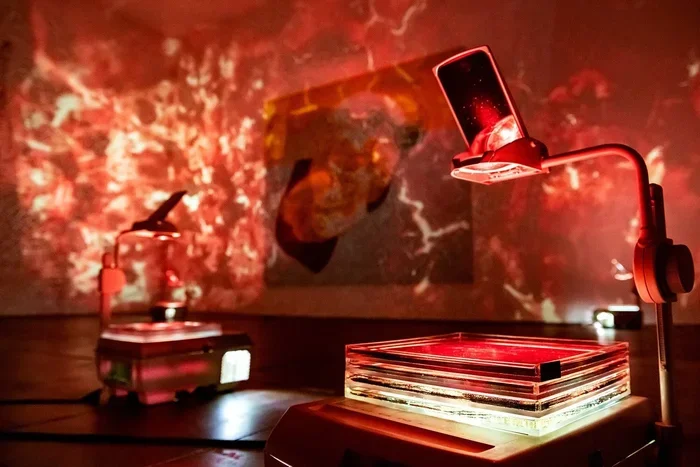
Warhol’s studio, The Factory, was a hub of creative activity. It was part art space, part production line, and part social club. And it was well-equipped with the kind of tools that most traditional artists would not recognize. Overhead projectors were commonly used in the studio to enlarge images and transfer them to larger surfaces.
The overhead projector allowed Warhol and his team to work quickly. They could project an image onto a wall or canvas, trace it, and then move on to the next piece. This assembly-line approach was central to Warhol’s philosophy. He wanted to produce art in a way that mirrored the mass production of consumer goods, which was a major theme in his work.
If you have ever used a projector to display something on a wall, you already understand the basic principle. Warhol took that everyday technology and turned it into an instrument of artistic expression. It is a great example of how artists can use any tool available to them to push creative boundaries.
How Warhol Used Projectors in His Creative Process
Understanding how Warhol actually used a projector requires a closer look at his step-by-step process. It was not as simple as turning on a machine and painting. Each stage was carefully planned and executed.
Step 1: Selecting the Image
Warhol often began with photographs. These could come from newspapers, magazines, or his own personal collection. He was drawn to images of celebrities, everyday objects, and events that captured the attention of popular culture. Marilyn Monroe, Campbell’s soup cans, and car crashes were all recurring subjects.
The choice of image was deliberate. Warhol wanted to comment on fame, consumerism, and the nature of modern life. The projector simply helped him transfer these images from a small photograph to a large canvas.
Step 2: Projecting and Tracing
Once the image was selected, it was projected onto the canvas. Warhol or one of his assistants would carefully trace the outline. This tracing served as a guide for the next steps. The level of detail in the tracing varied depending on the final piece.
Some works required very precise tracing, while others allowed for more freedom and improvisation. The projector gave Warhol a starting point, but the creative decisions came later. He chose the colors, the composition, and the number of repetitions that would define each piece.
Step 3: Silkscreen Printing
After the initial tracing, Warhol often moved to silkscreen printing. This technique allowed him to reproduce the same image multiple times, each in different colors. The projector helped create the original stencil, and the silkscreen process turned that stencil into a print.
The combination of projection and silkscreen printing was powerful. It allowed Warhol to produce works that looked both handmade and machine-made. This tension between the human hand and mechanical reproduction is at the heart of his artistic identity.
For those interested in how modern artists use similar tools today, you might enjoy reading about Can I Use A Projector On My Wall to understand the basics of projecting images for creative work.
Step 4: Refinement and Finishing
Once the silkscreen print was made, Warhol would often add finishing touches by hand. He might paint details, adjust colors, or add text. The final piece was a blend of mechanical reproduction and human touch. The projector played a role in the early stages, but the final artwork was a collaboration between technology and the artist’s vision.
Warhol’s Studio: The Factory
No discussion of Warhol’s use of projectors would be complete without talking about The Factory. This was more than just a studio. It was a creative laboratory where Warhol and his team experimented with new techniques, produced art at scale, and pushed the boundaries of what art could be.
The Factory was equipped with all the tools Warhol needed. Photographic darkrooms, silkscreen equipment, and yes, projectors. The space was designed to facilitate production, and projectors were an essential part of that workflow. They allowed the team to work on large-scale pieces efficiently and consistently.
The Factory also represented Warhol’s broader philosophy about art. He believed that art should be accessible and that the creative process did not have to be mysterious or exclusive. Using a projector to trace images was a practical choice that reflected this belief. It was a democratic tool that anyone could use, and Warhol wanted his art to reflect that accessibility.
The Debate: Is Using a Projector Cheating?
Warhol’s use of projectors has sparked debate among art critics and enthusiasts for decades. Some people believe that using a projector to trace an image is not real art. They argue that true artistry comes from the hand and the eye working together without mechanical assistance.
Others see it differently. They argue that Warhol was making a statement about the nature of art in a mass-produced world. By using tools like projectors and silkscreens, he was commenting on how images are reproduced and consumed in modern society. The projector was not a shortcut. It was a statement.
What do art historians say? Most agree that Warhol’s methods were deliberate and purposeful. He did not use a projector because he could not draw well. He used it because it fit his vision. His background in commercial illustration gave him the skills to work with these tools effectively. The projector was simply one element of a larger creative system.
For more on how projectors are used in creative settings, check out Can I Use Blackout Curtains As A Projector Screen for interesting ideas about projector surfaces.
Warhol’s Legacy and the Role of Technology in Art
Warhol’s use of projectors and other mechanical tools has had a lasting impact on the art world. He showed that technology could be a partner in the creative process rather than something to be feared or avoided. His approach paved the way for other artists who embraced digital tools, projectors, and mechanical processes in their work.
Today, many contemporary artists use projectors to create large-scale murals, installations, and mixed-media works. The technique Warhol popularized has become a standard practice in the art world. His willingness to experiment with new tools continues to inspire artists who want to push the boundaries of their medium.
Warhol also influenced how we think about what counts as art. His use of commercial tools and processes challenged the idea that art must be made by hand. This shift in thinking has opened the door for countless artists who work with digital media, photography, and projection art.
Looking ahead, it is clear that the relationship between technology and art will only continue to evolve. Warhol was ahead of his time in recognizing that tools like projectors could be used to create something beautiful and meaningful. His legacy reminds us that creativity is not limited by the tools we use but by the vision we bring to them.
If you are curious about how technology continues to shape creative work, you might also enjoy learning about Can I Turn My Iphone Into A Projector to see how accessible projector technology has become today.
Common Myths About Warhol and Projectors
There are several myths surrounding Warhol’s use of projectors that are worth addressing. First, some people believe that Warhol could not draw at all and relied entirely on projectors. This is not true. Warhol was a skilled illustrator who had formal training in commercial art. The projector was a tool he chose to use, not a crutch he depended on.
Another myth is that Warhol did all the work himself. In reality, he had a team of assistants at The Factory who helped with many aspects of production. The projectors were used by the entire team, and the collaborative nature of the work was part of the process.
Finally, some people think that using a projector makes art less valuable. This is a subjective opinion, not a fact. Warhol’s works are among the most valuable and celebrated in the art world, and his use of projectors is widely recognized as a key part of his innovative approach.
Quick Tips: Using a Projector for Art Projects
If you are inspired by Warhol and want to try using a projector for your own art projects, here are a few tips to get started:
- Start with a high-contrast image. The clearer your source image, the easier it will be to trace or transfer.
- Use a stable surface. Make sure your canvas or wall is secure and the projector is positioned steady to avoid blurry projections.
- Work in a darkened room. Reducing ambient light will make the projected image sharper and easier to see.
- Trace lightly at first. Use a pencil so you can make adjustments before committing to permanent marks.
- Experiment with scale. Try projecting the same image at different sizes to see how it changes the feel of the final piece.
- Combine tools. Like Warhol, try pairing projection with other techniques like painting, collage, or printmaking.
Expert Insights on Warhol’s Methods
Art experts generally agree that Warhol’s use of projectors was both practical and conceptual. On a practical level, projectors helped him work efficiently and accurately. On a conceptual level, they reinforced his interest in mechanical reproduction and the mass production of images.
Some art historians point out that Warhol’s methods were influenced by his early career in commercial illustration. In advertising and magazine work, precision and speed were essential. The projector was a natural extension of the tools he already knew how to use. He simply brought those commercial techniques into the world of fine art.
Others note that Warhol’s approach anticipated the digital age. Today, artists use software to project and manipulate images digitally. Warhol was doing something similar with analog tools decades earlier. His willingness to embrace new technology set a precedent for future generations of artists.
For those interested in how modern tools like projectors are used in everyday creative settings, you might also want to read about Can I Use A Sheet As A Projector Screen for practical tips on improvised projection surfaces.
Conclusion
So, did Andy Warhol use a projector? The answer is a resounding yes. Projectors were a vital part of his creative process, helping him trace, scale, and reproduce images that became some of the most recognizable works of pop art in history. From The Factory to his collaborations with silkscreen printing, the projector was never just a tool. It was a symbol of Warhol’s willingness to embrace technology, challenge conventions, and redefine what art could be.
Warhol’s legacy continues to inspire artists and creatives around the world. His innovative use of tools like projectors reminds us that creativity is not about following rules. It is about finding new ways to express ideas and connect with audiences. Whether you are a seasoned artist or just starting out, there is something to learn from the way Warhol approached his craft.
The next time you look at a Warhol piece, remember the projector that helped bring it to life. That beam of light was not just a technical tool. It was a bridge between the photograph and the masterpiece, between the everyday and the extraordinary.
Frequently Asked Questions
Did Andy Warhol invent the use of projectors in art?
No, Warhol did not invent the use of projectors in art. However, he was one of the first major artists to integrate projectors into a fine art workflow in a systematic way. His approach made the technique widely recognized and influential in the pop art movement and beyond.
What kind of projector did Andy Warhol use?
Warhol primarily used photographic projectors and overhead projectors in his studio. These tools allowed him to project images from photographs onto canvas or walls, where they could be traced and then developed into full artworks using paint or silkscreen techniques.
Can anyone use a projector to create art like Warhol?
Absolutely. Warhol’s methods were practical and accessible. Anyone with a projector, a canvas, and a source image can experiment with tracing and projection techniques. Warhol himself encouraged experimentation and believed that art should be open to everyone.
Did Warhol do all the work himself, or did he have help?
Warhol worked with a team of assistants at his studio, The Factory. His assistants helped with many parts of the process, including projecting images, tracing, and printing. The collaborative nature of the work was an important part of Warhol’s artistic philosophy.
Is using a projector to create art considered legitimate?
Yes, using a projector is widely considered a legitimate artistic method. Warhol’s success and critical acclaim prove that mechanical tools can be used to create meaningful, valuable art. The debate is more about philosophy than about the validity of the technique itself.
Where can I see Warhol’s projector-based artworks in person?
Many of Warhol’s most famous works are held in major museums and galleries around the world. The Andy Warhol Museum in Pittsburgh, Pennsylvania, has the largest collection of his works. Other institutions like the MoMA in New York and the Tate Modern in London also hold significant pieces.