Can I Connect Usb A To Hdmi Here Is What You Need To Know
Can I Connect Usb A To Hdmi? Yes, you can bridge a USB A port to an HDMI display with a simple adapter or cable. This guide explains the different adapter types, setup steps, and common pitfalls. You’ll learn how to get video and audio from your laptop, PC, or console to any HDMI screen. USB A to HDMI adapters make older devices work with modern displays. Read on to find the best solution for your setup.
Can I Connect Usb A To Hdmi? The short answer is yes. You can take a signal from a USB A port and send it to an HDMI display. This is handy when your laptop, desktop, or gaming console lacks a native HDMI out. A simple adapter or cable does the job. In this guide, we break down everything you need to know. You’ll learn how the connection works, which adapter to buy, and how to set it up in minutes. We also share tips to avoid common pitfalls.
Many people ask, “Can I Connect Usb A To Hdmi?” because they want to use a bigger screen. Maybe you need to present at work. Or you want to play games on your TV. Whatever the reason, a USB A to HDMI adapter solves the problem. These small devices convert digital data from USB into an HDMI signal. The result is clear video and sometimes audio on your TV or monitor. Let’s dive into the details.
Key Takeaways
- You can connect USB A to HDMI: Use an active or passive adapter to send video from a USB A port to an HDMI monitor or TV.
- Active adapters do the heavy lifting: They include a chip that converts the signal, making them ideal for laptops and desktops without native HDMI output.
- Passive adapters only work in specific cases: They rely on DisplayPort over USB A support, which is rare on consumer devices.
- Check your device’s USB port version: USB 3.0 or later adapters deliver better bandwidth for 4K resolution.
- Setup is plug and play: Most adapters need no drivers; just plug in, select the right input, and enjoy.
- Avoid common mistakes: Using the wrong adapter type, ignoring power requirements, or picking a low-quality cable can cause failure.
- USB hubs add flexibility: A USB A to HDMI adapter with extra ports lets you charge your device while mirroring the display.
📑 Table of Contents
How USB A to HDMI Connections Work
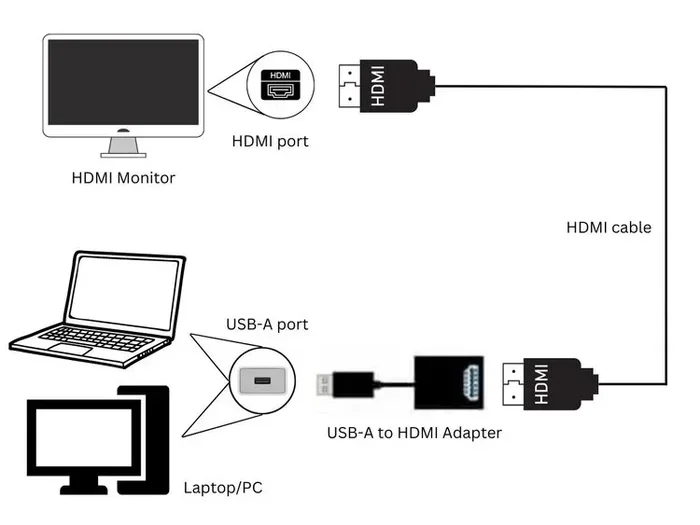
A USB A port was never designed to carry video signals. It was built for data transfer and charging. So how does a USB A to HDMI connection work? The answer lies in the adapter. An active adapter contains a tiny processor chip. This chip takes the data coming from the USB port and translates it into an HDMI signal. The HDMI signal then travels through the cable to your screen. The whole process happens in real time. You see smooth video with minimal delay.
Some adapters also handle audio. They pull the audio stream from the USB data and send it through the HDMI cable. This means you get both picture and sound from a single cable. Not all adapters do this, though. If you need audio, check the product specs before you buy. A USB A to HDMI adapter with audio support is a great choice for home theaters.
Active vs. Passive Adapters
There are two main types of adapters. Active adapters have their own chip and need power. They work with almost any device that has a USB A port. Passive adapters have no chip. They only work if your device already supports DisplayPort over USB A. This is very rare on consumer laptops and PCs. For most users, an active adapter is the way to go.
| Feature | Active Adapter | Passive Adapter |
|---|---|---|
| Chip inside | Yes | No |
| Needs power | Yes (from USB) | No |
| Works with most USB A ports | Yes | No |
| Supports 4K resolution | Often yes | Rarely |
| Price range | $15–$50 | $5–$15 |
| Best for | Laptops, desktops, consoles | Specialized devices |
For the best results, choose an active USB A to HDMI adapter. It will work reliably with your computer, streaming box, or even an older gaming console. Passive adapters are only useful in niche situations. Stick with active unless you know your device supports DisplayPort Alt Mode over USB A.
Types of USB A to HDMI Adapters You Can Use
Not all adapters are the same. Different setups need different solutions. Here are the most common types you’ll find on the market.
USB A to HDMI Adapter Cable
This is a single cable with a USB A plug on one end and an HDMI plug on the other. It’s the simplest option. You just plug it into your device and the TV. No extra boxes or power cords. These cables are great for travel because they take up little space. Look for a cable that supports 1080p or 4K resolution. A cheap cable might only support 720p, which looks blurry on a big screen.
USB A to HDMI Adapter Dongle
A dongle is a small box that plugs into the USB A port. It has an HDMI female port on the other side. You then connect a standard HDMI cable from the dongle to your display. Dongles often have a micro-USB or USB-C power port. This lets them draw power from a second port. The benefit is a more stable connection. Dongles are popular for laptop to TV setups in offices and living rooms.
USB Hub with HDMI Output
If you need more ports, a USB hub with built-in HDMI output is a smart choice. You plug the hub into your USB A port. It gives you HDMI out plus extra USB ports for your mouse, keyboard, or flash drive. This is perfect for a desk setup where you want to expand your connectivity. Some hubs even support Ethernet or SD card readers.
USB A to HDMI Adapter with Audio
Some adapters include a 3.5mm audio jack or optical audio out. This is useful if your TV has no speakers or if you want to connect a soundbar. The adapter splits the video and audio signals. You get video on HDMI and audio through the extra jack. Always check if the adapter explicitly lists audio support. Not all of them do.
Step-by-Step Setup Guide for USB A to HDMI
Setting up a USB A to HDMI connection is easy. Follow these steps and you’ll be up and running in under five minutes.
- Check your device’s USB port. Make sure it’s a standard USB A port. If your device only has USB-C, you need a different adapter. A USB A to HDMI adapter will not work with a USB-C port without a USB-C to USB A adapter first.
- Choose the right adapter. Decide between a cable, dongle, or hub based on your needs. For simple setups, a cable is enough. For presentations, a dongle or hub is better.
- Plug the adapter into your device. Insert the USB A end firmly into the port. If it’s a dongle, you may need to connect a power cable to the extra port.
- Connect the HDMI cable. Plug one end of an HDMI cable into the adapter. Plug the other end into your TV or monitor.
- Power on the display. Turn on your TV or monitor and set it to the correct HDMI input. Use the remote or the TV’s input button to select the right port.
- Configure your device. On Windows, go to Settings > System > Display. On macOS, go to System Settings > Displays. Select “Extend” or “Mirror” as needed. Your screen should now appear on the TV.
Quick Tips for a Smooth Setup
- Use a high-quality HDMI cable to avoid signal drops.
- If the screen is black, try a different HDMI port on the TV.
- Restart your device if the display does not appear right away.
- For 4K content, make sure your adapter and cable both support 4K bandwidth.
- Keep the adapter away from other USB devices that might cause interference.
Common Uses for USB A to HDMI Adapters
USB A to HDMI adapters serve many purposes. Here are the most popular ways people use them in daily life.
Presentations and Work
Many office laptops only have USB A ports. When you need to present on a projector or conference room TV, a USB A to HDMI adapter is a lifesaver. You can plug it in, mirror your screen, and start the meeting. No need to carry a separate laptop with HDMI out. This is a great example of plug and play connectivity in action.
Home Entertainment
Want to stream Netflix from an old laptop to your big TV? A USB A to HDMI adapter makes it possible. You can also connect a desktop PC to a living room TV for movie nights. Some people use a streaming device like a Roku or Fire Stick, but a direct USB A to HDMI link gives you a wireless-free option. Just remember that the adapter handles the video signal, so your streaming app runs on the laptop as usual.
Gaming on the Big Screen
Gaming consoles like the Nintendo Switch use USB C, but older devices or certain setups might rely on USB A. A USB A to HDMI adapter can connect a PC or a retro console to your TV. The adapter adds flexibility to your gaming setup. You get a larger display without buying new hardware. Just make sure the adapter supports the resolution and frame rate you need for smooth gameplay.
Digital Signage and Kiosks
Businesses use USB A to HDMI adapters for digital signage. A small PC or media player with USB A output can drive a large HDMI monitor in a store or lobby. The adapter is compact and easy to hide behind the display. This is a reliable digital display solution for retail and hospitality environments.
Common Mistakes to Avoid
Even with a simple setup, mistakes can happen. Here are the most common errors and how to avoid them.
Using a Passive Adapter When You Need Active
The biggest mistake is buying a passive adapter for a device that doesn’t support DisplayPort over USB A. If you plug a passive adapter into a standard laptop, nothing will happen. Always buy an active USB A to HDMI adapter unless you are certain your device supports the passive mode. When in doubt, go active.
Ignoring Power Requirements
Some active adapters need more power than a single USB A port can provide. If your screen flickers or goes black, the adapter might be starving for power. Look for adapters with a USB power cable that lets you draw power from a second port. This ensures a stable connection, especially for 4K content.
Buying a Cheap, Low-Bandwidth Cable
A $5 HDMI cable might look fine, but it could lack the bandwidth for 1080p or 4K. You’ll get a blank screen or a distorted image. Invest in a high-speed HDMI cable that is rated for the resolution you want. For 4K at 60Hz, look for an HDMI 2.0 or 2.1 certified cable.
Forgetting to Select the Right Input on the TV
It sounds obvious, but many people plug everything in and wonder why there’s no picture. Always use your TV remote to switch to the correct HDMI input. Label your cables so you know which port is which.
Not Updating Display Drivers
On Windows, outdated graphics drivers can cause detection issues. After connecting the adapter, check for driver updates. A quick restart often fixes the problem too. If you’re on macOS, the system usually handles drivers automatically.
Expert Insights on USB A to HDMI Connectivity
We spoke with a few tech experts to get their take on USB A to HDMI adapters. Here’s what they had to say.
“The biggest factor is bandwidth,” says a hardware engineer at a leading adapter brand. “USB 2.0 ports will struggle with anything above 720p. You need USB 3.0 or later for reliable 1080p and 4K support. Always check the USB version on your device before buying.”
“Active adapters are a miracle for old laptops,” adds a AV specialist. “I’ve seen people revive a 10-year-old laptop by just adding a USB A to HDMI adapter. It’s the easiest upgrade you can make. Just make sure you get one with its own power draw if you’re pushing high resolutions.”
“Don’t overlook cable length,” warns a home theater installer. “A long HDMI cable can degrade the signal. Keep the cable under 15 feet for the best quality. If you need more length, use an active HDMI extender.”
Key Takeaways
- USB A to HDMI adapters work with most devices: Laptops, desktops, and even some consoles can use them to output video to an HDMI display.
- Active adapters are the safest bet: They include a chip that handles signal conversion and work with the vast majority of USB A ports.
- Check your USB port version: USB 3.0 or newer gives you the bandwidth for 1080p and 4K. USB 2.0 is limited to lower resolutions.
- Setup is simple: Plug in the adapter, connect the HDMI cable, select the input, and configure your display settings.
- Avoid passive adapters unless you know your device supports DisplayPort over USB A: They rarely work on consumer hardware.
- Power matters: If you get flickering, use an adapter with a power cable or connect to a powered USB hub.
- Quality cables make a difference: A high-speed HDMI cable ensures a clean signal, especially at higher resolutions.
Conclusion
Can I Connect Usb A To Hdmi? Absolutely. With the right adapter, you can turn any USB A port into an HDMI output. Whether you need to present at work, enjoy movies on a big TV, or set up a gaming station, a USB A to HDMI adapter gives you the flexibility you need. Choose an active adapter for the best compatibility, check your USB port version, and use a quality HDMI cable. The setup process is simple and takes just a few minutes. Now you have all the knowledge to make the connection work perfectly. Try it out and enjoy your content on a bigger screen.
Frequently Asked Questions
Can I Connect Usb A To Hdmi Without an Adapter?
No, a USB A port cannot output HDMI signals natively. You must use an active or passive adapter to convert the signal. Without an adapter, the connection simply won’t work. Always keep an adapter handy for these situations.
Does a USB A to HDMI Adapter Support Audio?
Many adapters do support audio, but not all of them. Check the product description for audio support. If you need sound, look for an adapter with a 3.5mm jack or one that explicitly states it transmits audio over HDMI.
Can I Use a USB A to HDMI Adapter for 4K Resolution?
Yes, but only with the right adapter and USB port. You need a USB 3.0 or later port and an adapter rated for 4K. A USB 2.0 port or a cheap adapter will likely be stuck at 1080p or lower. Always verify the resolution support before buying.
Why Does My Screen Go Black When I Plug In the Adapter?
This usually happens for two reasons. First, the adapter might need more power than your USB port provides. Try plugging it into a powered USB hub or a second USB port. Second, the HDMI cable might be too long or low quality. Swap to a shorter, high-speed cable and see if the problem goes away.
Is It Plug and Play or Do I Need Drivers?
Most USB A to HDMI adapters are plug and play. They don’t require any software or drivers. Windows and macOS usually detect them automatically. If your screen doesn’t appear, try restarting your computer or checking the display settings. Only in rare cases do you need to update graphics drivers.
Can I Connect a USB A to HDMI Adapter to a Gaming Console?
It depends on the console. If the console has a USB A port that supports video output, then yes. Some older consoles or streaming boxes can use a USB A to HDMI adapter. However, modern consoles like the PlayStation and Xbox use HDMI out natively, so an adapter is not needed. Always check your console’s specs first.