Does Walkie Talkie Work Without Cellular Data Explained
Does walkie talkie work without cellular data? The short answer is yes — most traditional walkie talkies operate entirely without any cellular connection, internet, or data plan. These handheld radios use radio frequencies to communicate directly between devices, making them perfect for emergencies, outdoor adventures, and areas with no cell service. Whether you choose FRS, GMRS, or CB radios, you can stay connected when it matters most, no data required.
Does walkie talkie work without cellular data? This is one of the most common questions people ask before heading out on a camping trip, preparing for emergencies, or heading to areas with poor cell coverage. The good news is that walkie talkies are designed to work independently of cellular networks. They use radio waves to send and receive voice messages directly between devices.
In this guide, we will explain exactly how walkie talkies work without cellular data. We will cover the different types of radios, their ranges, and which ones are best for offline communication. Whether you are a hiker, a parent, or a preparedness enthusiast, this article has everything you need to know.
## How Walkie Talkies Actually Work
Before we dive into whether walkie talkies need cellular data, let us understand how they actually work. A walkie talkie is a handheld two-way radio. It sends and receives audio signals through the air using radio frequencies.
When you press the button on a walkie talkie and speak, the device converts your voice into a radio signal. That signal travels through the air to the other walkie talkie. The receiving device then converts the signal back into sound. This process happens almost instantly.
The key thing to understand is that walkie talkies do not need cell towers. They do not need Wi-Fi. They do not need an internet provider or a phone line. They only need to be within range of each other.
### Radio Frequencies Explained
Walkie talkies operate on specific radio frequency bands. In the United States, the most common bands are:
- FRS (Family Radio Service): Used for short-range communication, typically up to 2 miles.
- GMRS (General Mobile Radio Service): Offers longer range, often up to 15 miles or more.
- CB (Citizens Band): Provides even longer range, sometimes up to 30 miles.
- MURS (Multi-Use Radio Service): A flexible option with good range and no license required.
Each of these bands uses different frequencies. This means devices on one band cannot talk to devices on another band. You must match the frequency and channel for communication to work.
## Does Walkie Talkie Work Without Cellular Data
Now let us answer the main question directly. Does walkie talkie work without cellular data? Yes, absolutely. Traditional walkie talkies are standalone devices that communicate through radio waves. They do not depend on cellular networks at all.
This is one of the biggest advantages of walkie talkies. When cell towers go down during a storm or natural disaster, walkie talkies keep working. When you are hiking in a remote mountain area with no cell service, walkie talkies still function. When you are at a campsite far from civilization, you can still talk to your group.
### Why Cellular Data Is Not Needed
Cellular data connects your phone to a network of towers owned by mobile carriers. Walkie talkies skip this entirely. They create their own communication network through radio signals. Think of it like this: a walkie talkie is its own little radio station that can both send and receive messages.
There is no monthly bill. There is no data plan. There is no subscription fee. You buy the device, add batteries, and you are ready to communicate. This makes walkie talkies incredibly reliable for situations where you cannot count on cellular service.
### Range Without Cellular Data
The range of a walkie talkie without cellular data depends on several factors:
- Terrain: Hills, buildings, and trees can block signals and reduce range.
- Power output: Higher wattage means stronger signals and longer range.
- Antenna quality: A better antenna improves signal strength and distance.
- Weather conditions: Rain and heavy clouds can slightly weaken radio signals.
- Obstacles: Walls, metal structures, and dense forests limit range.
For FRS radios, expect about 1 to 2 miles in open areas. For GMRS radios, 5 to 15 miles is realistic. CB radios can reach 20 to 30 miles under ideal conditions. Always check the manufacturer’s claimed range, but keep in mind that real-world conditions usually reduce that number.
## Types of Walkie Talkies That Don’t Need Cellular Data
Not all walkie talkies are the same. Some are designed for casual use, while others are built for serious communication. Here are the main types that work without any cellular data.
### FRS Walkie Talkies
FRS walkie talkies are the most common type. You see them in toy stores, department stores, and outdoor shops. They are affordable, easy to use, and do not require a license.
These radios typically have a range of 1 to 2 miles. They are perfect for family outings, theme parks, and neighborhood games. Most FRS radios come with built-in rechargeable batteries and compact designs.
### GMRS Walkie Talkies
GMRS radios offer more power and longer range than FRS. They require a license from the FCC, but the license is relatively easy to obtain. A single license covers your entire family.
GMRS radios can reach 5 to 15 miles in good conditions. They are great for camping trips, hunting trips, and emergency preparedness. Some GMRS radios also support repeater systems, which boost the signal and extend range even further.
### CB Radios
CB radios have been around for decades. They are popular among truckers, off-road enthusiasts, and preppers. CB radios do not require a license and can reach impressive distances.
These radios operate on 40 channels and use AM or FM modulation. They are larger than FRS or GMRS radios, but they offer excellent range and signal strength. If you want serious off-grid communication, a CB radio is a strong choice.
### MURS Radios
MURS radios operate on five specific frequencies. They do not require a license and offer decent range. MURS radios are a great middle-ground option between FRS and GMRS. They are less common but very effective for outdoor and emergency use.
## Walkie Talkie Apps vs Traditional Radios
Many people wonder about walkie talkie apps for smartphones. Apps like Zello, Voxer, and TeamTalk mimic the walkie talkie experience on your phone. But there is a big difference between these apps and traditional walkie talkies.
### How Walkie Talkie Apps Work
Walkie talkie apps use your phone’s internet connection to send voice messages. They turn your smartphone into a push-to-talk device. However, they need either Wi-Fi or cellular data to function.
So if you are in an area with no cell service and no Wi-Fi, a walkie talkie app will not work. This is a critical limitation that many people do not realize until they need the app most.
### When Apps Make Sense
Walkie talkie apps are useful when you have a reliable internet connection. They are great for:
- Team coordination at events
- Communication within a building that has Wi-Fi
- Quick messaging when you are away from your traditional radios
- Connecting with people in different cities or countries over the internet
But for true offline communication, nothing beats a traditional handheld radio.
## When You Might Need Cellular Data for Walkie Talkies
There are some situations where walkie talkies do rely on cellular data or internet. Understanding these cases helps you make the right choice.
### Smartphone Walkie Talkie Apps
As we discussed, apps like Zello need data or Wi-Fi. If your plan is to use your phone as a walkie talkie, you need some form of internet connection. This is fine in urban areas with good coverage, but it fails in remote locations.
### Connected Walkie Talkie Systems
Some modern walkie talkie systems connect to the internet to extend their range. These devices use cellular data or Wi-Fi to bridge communication over long distances. They combine the simplicity of a radio with the reach of the internet.
For example, some systems let you talk to someone hundreds of miles away by routing your voice through a server. This is useful for business teams or families spread across different locations. But it does require a data connection.
### Bluetooth and Mesh Networking
Some newer devices use Bluetooth or mesh networking to communicate without cellular data. Bluetooth walkie talkies work over short distances, typically up to 30 feet. Mesh networks allow devices to relay messages through each other, extending the range without any internet.
These technologies are interesting but have limitations. Bluetooth range is very short, and mesh networks work best with multiple devices in close proximity.
## How to Choose the Right Walkie Talkie for Offline Use
Choosing the right walkie talkie depends on your needs. Here are some factors to consider before making a purchase.
### Range Requirements
Think about where you will use the walkie talkies. For a day trip to a local park, FRS radios are plenty. For a multi-day camping trip in the mountains, consider GMRS or CB radios with higher power output.
### Battery Life
Battery life is crucial for offline use. You do not want your radios dying in the middle of an adventure. Look for radios with long battery life and consider carrying a portable charger. Some models use rechargeable batteries, while others run on replaceable AA or AAA batteries.
### Durability
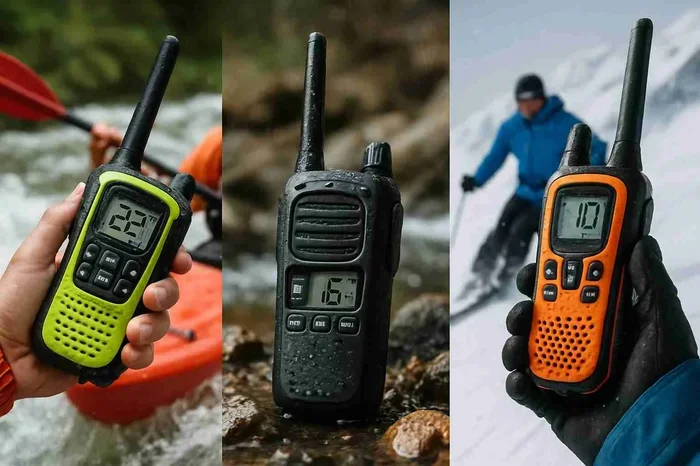
If you are using walkie talkies outdoors, they need to be tough. Look for models with an IP rating for water and dust resistance. Rubber armor coatings protect against drops and impacts. A durable radio will last through many adventures.
### Number of Channels
More channels mean more options for communication. FRS radios typically have 14 to 22 channels. GMRS radios offer 30 channels. CB radios have 40 channels. More channels reduce the chance of interference from other users.
### Size and Weight
If you are carrying walkie talkies on a hike, weight matters. FRS radios are usually the lightest and most compact. GMRS radios are slightly larger but still portable. CB radios are the bulkiest option. Choose a size that fits comfortably in your hand or on your belt.
## Common Mistakes People Make with Walkie Talkies
Many people make mistakes that reduce the effectiveness of their walkie talkies. Here are some common pitfalls to avoid.
### Assuming All Walkie Talkies Work the Same Way
Not all walkie talkies are created equal. FRS, GMRS, CB, and MURS radios all have different capabilities. Make sure you buy the right type for your needs. Do not assume a cheap FRS radio will reach 20 miles just because the box says so.
### Forgetting to Check the Battery
Nothing is more frustrating than a dead battery when you need to communicate. Always check the battery level before heading out. Charge rechargeable batteries fully and carry spare batteries for devices that use replaceable ones.
### Using the Wrong Frequency or Channel
If two walkie talkies are not on the same frequency or channel, they cannot communicate. This sounds obvious, but it happens all the time. Make sure all devices in your group are set to the same channel before you need them.
### Overestimating the Range
Manufacturers often advertise ideal conditions for range. In reality, buildings, trees, hills, and other obstacles reduce the distance significantly. Always assume the real-world range will be less than what is advertised.
### Ignoring Local Regulations
Different types of radios have different rules. FRS does not require a license. GMRS does. CB does not. MURS does not. Make sure you understand the regulations in your area before using a radio. Using an unlicensed radio on the wrong frequency can result in fines.
## Expert Tips for Better Walkie Talkie Communication
Here are some practical tips from experienced users to get the most out of your walkie talkies.
- Hold the radio upright: This improves the antenna’s performance and signal strength.
- Stay in open areas: Move to higher ground or open spaces for better signal reception.
- Use earpieces: They improve privacy and reduce background noise.
- Test your range before you need it: Set up your radios at the distances you expect to use and test them.
- Keep the antenna fully extended: A retracted antenna significantly reduces range.
- Use voice clarity features: Many radios have noise-canceling features that make speech clearer.
## Quick Tips for Offline Walkie Talkie Use
Here are some quick tips to remember when using walkie talkies without any data connection:
- Always carry extra batteries or a portable charger.
- Agree on a channel and code words with your group before heading out.
- Keep the radio away from metal objects that can block signals.
- Test your device in the actual environment where you plan to use it.
- Store your walkie talkies in a dry, safe place when not in use.
## Conclusion
So, does walkie talkie work without cellular data? The answer is a clear and definitive yes. Traditional walkie talkies are self-sufficient communication devices that rely on radio frequencies, not cellular networks. They work in the wilderness, during emergencies, and anywhere else where cell service is unreliable or unavailable.
Whether you choose FRS, GMRS, CB, or MURS radios, you get reliable offline communication without any monthly fees or data plans. Just add batteries, tune to the same channel, and you are ready to talk.
Walkie talkie apps on smartphones are useful in some situations, but they require internet access. For true independence from cellular networks, a traditional handheld radio is the way to go.
The next time you plan a camping trip, a hiking adventure, or you are preparing for an emergency, consider adding walkie talkies to your gear. They are affordable, reliable, and one of the best tools for staying connected when it matters most.
Key Takeaways
- Traditional walkie talkies work completely offline: They use radio frequencies, not cellular networks, so no data or internet connection is needed.
- FRS and GMRS radios are the most popular offline options: They are affordable, easy to use, and great for families and outdoor trips.
- Walkie talkie apps on smartphones usually need data or Wi-Fi: Apps like Zello and Voxer require an internet connection to send messages.
- CB radios and ham radios offer longer range: These are ideal for serious preppers and off-grid communication needs.
- You can connect devices without Wi-Fi using direct methods: Bluetooth and mesh networking allow some devices to communicate offline.
- Battery life matters for offline use: Always carry spare batteries or a portable charger when using walkie talkies in remote areas.
Frequently Asked Questions
Can walkie talkies work in areas with no cell service?
Yes, traditional walkie talkies work perfectly in areas with no cell service. They use radio frequencies to communicate directly between devices and do not need cell towers, Wi-Fi, or any internet connection.
Do I need a license to use a walkie talkie?
It depends on the type. FRS and MURS radios do not require a license. GMRS radios require an FCC license, which is easy to obtain and covers your entire family. CB radios also do not require a license.
How far can walkie talkies reach without cellular data?
The range depends on the type of radio. FRS radios typically reach 1 to 2 miles. GMRS radios can reach 5 to 15 miles. CB radios can go 20 to 30 miles under ideal conditions. Real-world range is usually less than the advertised range.
Can I use a walkie talkie app without data?
No, walkie talkie apps like Zello and Voxer require either Wi-Fi or cellular data to send messages. They cannot function offline. If you need true offline communication, use a traditional handheld radio instead.
Are walkie talkies better than cell phones for emergencies?
Walkie talkies can be better for local communication during emergencies because they do not depend on cell towers or internet infrastructure. When power outages or natural disasters knock out cell service, walkie talkies keep working as long as they have power.
What is the best walkie talkie for camping?
For camping, FRS or GMRS radios are the best choices. They are lightweight, easy to use, and offer good range. Look for models with long battery life, water resistance, and multiple channels for the best experience on your trips.